Lawson Field, Fort Benning, Georgia, August 1946….At the command of their jump leader these twenty-one students of the Airborne School climb aboard a waiting Douglas C-47 of the 75th Troop Carrier Squadron which will take them up for a practice jump. After losing its cargo the plane will return quickly and pick up another load of jumpers without waiting long enough to turn off its motor.
Since the inception of airborne warfare, the practice of using parachutes to insert troops into combat zones without land passage has turned the tides of conflicts. Commanders use airborne forces to seize the initiative. A brigade of paratroopers can envelop the ground from the sky in moments, allowing an army to strike deep inside enemy territory to gain key terrain and rapidly build combat power.
Paratroopers today learn their craft in the Basic Airborne Course at Fort Benning, Georgia, where soldiers leapt into history 85 years ago.
On Aug. 16, 1940, 48 volunteer members of the Army Parachute Test Platoon jumped from a Douglas B-18 Bolo bomber at 1,500 feet. The jump was less than 45 days after the establishment of the platoon and marked the true beginning of U.S. airborne forces.
U.S. Army Paratroopers with 2nd Battalion, 505th Parachute Infantry Regiment, 3rd Brigade Combat Team, 82nd Airborne Division conduct integrated Joint Force Entry training in Bardufoss, Norway May 13, 2025 during Swift Response, a supporting exercise of DEFENDER 25. Demonstrating global deterrence and the U.S. Army’s ability to rapidly deploy U.S.-based combat power in Europe and the Arctic region alongside Allies and partners, DEFENDER 25 brings U.S. troops together with forces from 29 Allied and partner nations to build readiness through large-scale combat training from May 11-June 24, 2025. (U.S. Army Reserve photo by Sgt. 1st Class Jeff VanWey)
Paratroopers everywhere now celebrate that date as National Airborne Day, commemorating “the bravery and daring spirit of sky soldiers,” according to the 2002 presidential proclamation that established the observance.
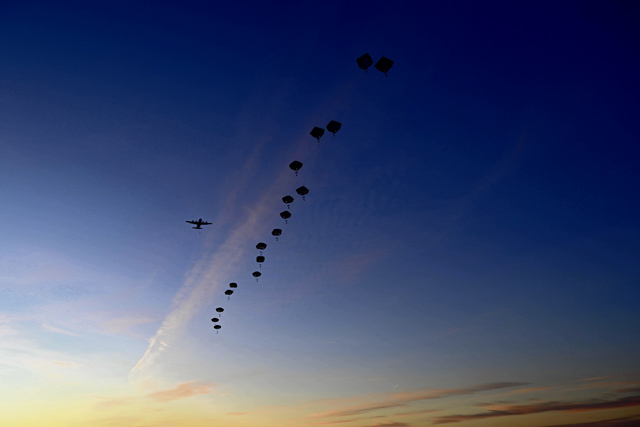
U.S. Army paratroopers assigned to 4th Battalion, 319th Airborne Field Artillery Regiment, 173rd Airborne Brigade, conduct an airborne operation at the 7th Army Training Command’s Grafenwoehr Training Area, Germany, Jan. 13, 2025. The 173rd Airborne Brigade is the U.S. Army Contingency Response Force in Europe, capable of projecting ready forces anywhere in the U.S. European, Africa or Central Commands’ areas of responsibility. (U.S. Army photo by Pfc. Francisco Torres)
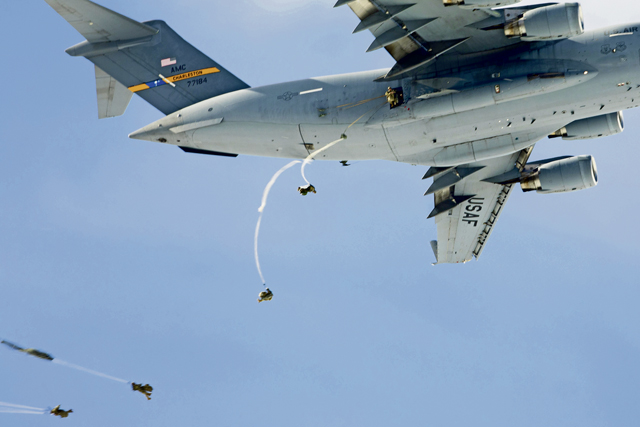
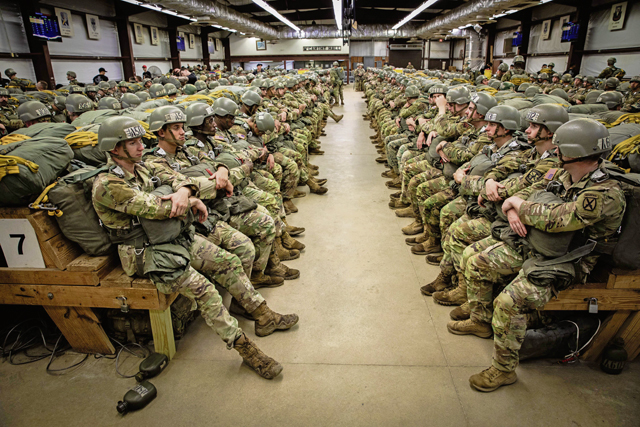
U.S. Army Soldiers, Sailors, Airmen and Marines attached to Charlie Company, 1st Battalion, 507th Parachute Infantry Regiment, rig up with T-11 parachutes before boarding a C-17 cargo aircraft to successfully conduct a static line jump during jump week at the Basic Airborne Course onto Fryar Drop Zone, at Fort Benning, Georgia, June 9, 2025. Basic Airborne Course is a three-week course where soldiers from all branches of the U.S. Armed Forces are trained in basic paratrooper techniques. It focuses on developing leadership, self-confidence, and aggression through physical and mental conditioning, preparing soldiers for parachute operations in combat. (U.S. Army photo by Staff Sgt. Eric Kestner)
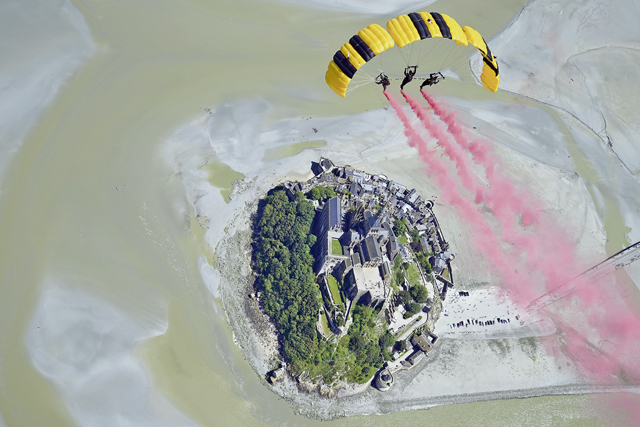
Sgt. 1st Class Rafael Torres, Sgt. 1st Class Zach Krietenstein, and Staff Sgt. Griffin Mueller of the U.S. Army Parachute Team fly in an advanced canopy maneuver for parachute jump at Mont Saint-Michel on 7 June 2024. The parachute jump was part of the 80th Anniversary of D-Day commemoration ceremonies in Normandy, France.(U.S. Army photo by Sgt. 1st Class Marcus Denniston)
 Twitter
 Facebook