 Twitter
 Facebook
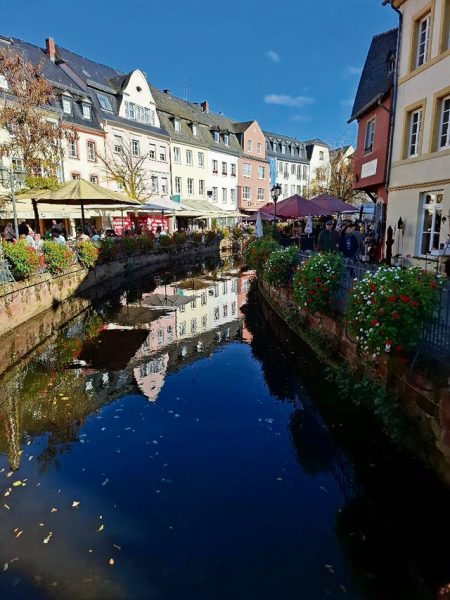
Many members of the Kaiserslautern Military Community are well acquainted with Trier, Germany’s oldest city along the Moselle River and its Roman ruins. But, did you know that there is a small town nearby, which is a secret gem and full of charming discoveries?
Saarburg sits on the banks of the Saar River, which meets the Moselle River at Konz. The town of about 7,600 people spans both sides of the river and attracts visitors worldwide with its rich history, charming shops, cozy cafés and restaurants set within a picturesque atmosphere.
Saarburg grew up around a hilltop fortress erected by Count Siegfried of Luxembourg in 964, a foundation that anchored settlement below on the Saar River and around the little Leuk Stream. The deliberate medieval diversion of the Leuk through the town to power mills created the dramatic central waterfall and established milling as a defining feature of the townscape and local economy.
The city received formal town rights in 1291 under imperial authority. This shaped market privileges, municipal structures and fortifications. The town then developed a compact street pattern around a market square and bridges over the river. The castle acted as the seat of local lordship and administration.
When visiting Saarburg, it is best to do so on foot, so let’s take a walk! Park near the train station and stroll over the “Altstadtbrücke” towards the tunnel, with the castle and a Protestant church towering above. On the right-hand side we’ll discover riverboats waiting to take passengers on short cruises, either upstream towards Mettlach and the Saarschleife (Saar loop) or downstream towards Trier.
Staden and bells
Passing by the riverboats, we’ll reach Staden, a historic area with very narrow medieval houses, a cozy maritime pub and the former family-owned Mabillon foundry. Bells were cast at the historic foundry in Saarburg for over 230 years until the end of 2002. The Mabillon family permanently settled in Saarburg in 1770, but the tradition of bell casting dates back to the 16th century. The craft is still being revived today through special projects. In 2023, a peace bell was cast that was created as part of the “all4peace” peace project and is one of three peace bells in the border triangle of Germany, Luxembourg, and France, intended to commemorate peace and human dignity.
The Glockengießerei is now a museum and cultural center called “Kulturgiesserei” (cultural foundry) that offers guided tours, concerts and other social events along with a small café.
Each year in mid-December the center hosts a Victorian Christmas Market with steampunk and actors in traditional costume of the days.
Left, right or straight ahead
Continuing on through the tunnel, we’ll make our next exciting discoveries! First, we’ll find a traffic circle, lovingly redecorated every two to three months, depending on the season. And, also a vineyard on steep Warsberg (hill) in the middle of town!
At this point we have several options: If we take a sharp right, we can walk up to the castle ruins for a magnificent view. Following the road to the right, we’ll hit upon the chairlift leading up to Warsberg, to discover a restaurant, a summer toboggan run, a Dutch vacation center and a spectacular view over the town and surroundings.
Another option is climbing up the hill on the steep walkway leading through the vineyard, or maybe taking this way down instead. The last choice is going to the left along Graf-Siegfried-Strasse, the main shopping street with a multitude of fashion shops, an ice-cream parlor, a nostalgic café and stores with home decorations.
Buttermarkt and the Leuk Stream
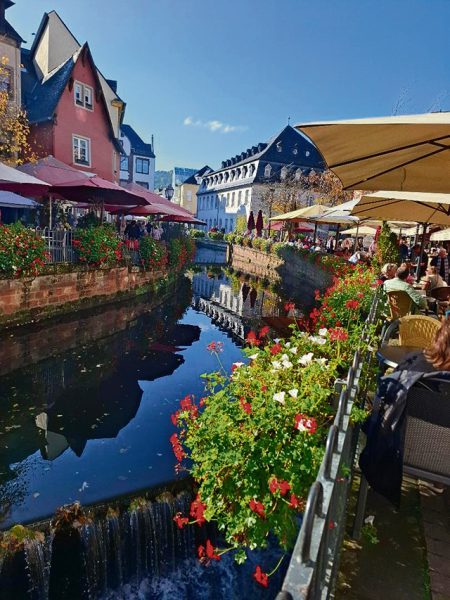
Passing through a left-hand archway brings us to the Buttermarkt, the town’s bustling main attraction, where restaurants, pubs and shops occupy historic buildings and attract visitors from around the world. Time to take a break with an ice-cream or coffee, hunt for souvenirs, with shops often open on Sundays. We may even strike up a conversation with a table neighbor speaking French, Dutch, Italian or with a New Zealand accent. The quaint market along the Leuk Stream, lined with seasonal flower displays is the perfect place to relax and enjoy the atmosphere.
A charming pedestrian bridge crosses directly above the waterfall, which plunges about 20 meters (65 feet) and once powered three historic mills, with Amüseum, a small local museum, just around the corner.
Hackenberger Mühle and the mill museum
Standing on the pedestrian bridge, there is a great view of the best‑known mill complex Hackenberger Mühle at the bottom of the waterfall. Most of the buildings visible today date from later centuries but rest on medieval milling tradition. Large external waterwheels and internal gearing transmitted power up into the mill rooms where millstones, belts and ancillary machinery performed successive stages of processing. Traditional mill operations ceased in the 1970s, but the Mühlenmuseum explains traditional milling techniques. Exhibits include original gears, grinding stones, the belt drive system, and educational displays or short films showing the “from grain to flour” process.
Ice sculptures and a Grape Madonna
Beyond the bridge, a sharp left by the Amüseum reveals a sweeping view of the waterfall, its thunderous roar reverberating for meters. The waterfall froze twice in recent years, in 2012 and again during the cold spell of winter 2017–2018, a rare event that turns the cascade into spectacular ice sculptures.
St Laurentius on the right is the Roman Catholic parish church that shapes Saarburg’s skyline alongside the castle, built on the site of a medieval chapel and today protected as a cultural monument. Rebuilt in 1854 after the original chapel was destroyed, the church contains interior treasures such as the late‑Gothic Grape Madonna dating to around 1500 and stained‑glass windows that flood the nave with a golden glow when sunlight shines through.
Laurentiusberg
Continuing our walk, this time rather steep downhill, we’ll pass by the mill museum and a few quaint houses. Some of the localities along the way have backyard sitting areas where visitors can enjoy a panoramic view over the river and the countryside beyond. At the very end the Leuk flows into the Saar River, ending our walking adventure.
Or, hop on the “Saartalbahn,” an enjoyable train ride that leads visitors around the town with a treasure chest full of historical insight. You can also walk the “Stolpersteine” (stumble stones) trail to commemorate Jews that lived in Saarburg in the early 1900’s: https://stolpersteine.in-saarburg.de/lageplan/
Festivals and fun
Saarburg is also known for its lively calendar of fun-filled events. A Fastnacht parade takes place during the season, the city offers a Spring Fair on March 29, and the Markttage (market days) in early July with live music and more around the town. A wine fest at Staden is in early September with torch swimmers and fireworks, “Goldener Oktober,” an artisan and farmers’ market takes place mid-month, as well as a Christmas Market at Buttermarkt during the holiday season. A further attraction is a virtual reality tour on an electric coach that can be booked via the city’s tourist info site and a bird of prey park just outside the town.
Klein, aber fein (small but precious) as Germans say, Saarburg is well worth a day trip and may even inspire you to visit again!


