 Twitter
 Facebook
Welcome back! After having explored Kaiserslautern’s early days and the age of Barbarossa, we’ll dive into the more recent developments and storms of history this week.
City rights
Almost ninety years after Barbarossa’s 38-year reign, Kaiserslautern received its city rights in 1276. This important milestone occurred when King Rudolf von Habsburg granted the settlement the privileges of an imperial city. In medieval Europe, such a charter wasn’t just an administrative formality; it marked a transformation. It gave the town the right to self-govern and build fortifications, all of which sparked economic growth and reinforced its strategic significance in the region and brought about a construction boom.
Construction of Stiftskirche began in 1250 and was completed about 1350 with an open market behind it. In 1284, King Rudolf of Habsburg gave permission for the construction of the St. Martin Monastery in Kaiserslautern, a monastery of the Franciscan Order founded in 1210. About ten years later, it was expanded to include a Gothic-style church, the present-day St. Martin’s Church. Thereafter, a wall was built to protect the city, a partial section can still be seen in the church’s courtyard.
At that time, the town’s population was about 3,000 people and was much smaller than today. The term “Kaysersluthern” was first recorded around 1538. The eastern city gate was at Kaiserbrunnen (corner Mainzer/Mannheimerstrasse), the town stretched along Steinstrasse to Marktstrasse, through today’s pedestrian zone to Pirmasenserstrasse and ending at the western gate at Richard-Wagner-Strasse. A small fountain marks the end of medieval Kaiserslautern, and a model (about 1600) can be viewed at Theodor Zink Museum in Steinstrasse.
Thirty Years’ War
Centuries came and went and while Kaiserslautern prospered it also found itself caught up in the broader, brutal currents of the Thirty Years’ War (1618–1648), a conflict that devastated vast areas in Central Europe. As tensions between Protestant and Catholic factions escalated, the Palatinate—of which Kaiserslautern was a central part—became a strategic flashpoint. In 1619–1620 Adam Stapf was commissioned to construct a fortress, a defensive structure reinforcing the town’s military resilience against the onslaught of hostile armies but was damaged during the enduring turmoil and later simply fell to ruins.
Despite all efforts, by 1648 only about 10 percent of the population was still alive and in the wake of widespread depopulation Count Johann Casimir understood that economic recovery and lasting stability depended on bringing new life to the region. His era saw a gradual return of people through a mix of measures: offering land grants and fiscal incentives, easing some of the harsh feudal restrictions, and investing in infrastructure improvements to signal that the region was rebuilding. He also invited people of Austria, Switzerland, France and northern Italy to immigrate to the region, resulting in the fact that about 70 percent of Palatinates in the region (and neighboring Saarland) have ancestry from these areas.
Turbulent Times
In the 18th century French and Germans continually fought until the French eventually destroyed Barbarossa’s castle and the city towers. In 1804 Napoleon visited the city to view the battlegrounds near Morlautern. During this visit Johann Goswin Müllinghoff asked him for approval to tear down the dilapidated Richardis Chapel at Stiftskirche, then opened his pharmacy there in 1811. As a sign of his gratitude, he added the imperial eagle over the door and the vintage-style pharmacy left of the church still bears the name “Adler Apotheke.”
In 1815 Kaiserslautern then came under Austrian-Bavarian rule and became a province of Bavaria in 1816, as did the whole Palatinate. It remained so until French troops occupied it again after World War I until 1930, on the brink of the National Socialist era.
Industrial Expansion and Modern Challenges
The next chapters of Kaiserslautern’s history unfold against the backdrop of Europe’s industrial revolution. During the 19th century, the city became a focal point of political change, illustrated by its active role in the Palatinate democratic revolution of 1848–49. On July 1, 1848 the train station was opened and as industrialization took hold, ironworks, cotton mills, and other manufacturing ventures spurred rapid urban growth. In 1862 the Pfaff Sewing Machine factory was opened, leading to global success. By 1900, Kaiserslautern had emerged as one of the foremost industrial centers in the region, bolstered by its thriving mechanical sectors that paved the way for its modern transformation.
The Fruchthalle was completed in 1846, originally intended as a covered market hall and later developed into a fine concert hall with excellent acoustics. During the groundbreaking ceremony in 1843 Bavarian King Ludwig I entitled the city “Barbarossastadt” for the first time. The Lauter River that flowed freely through the city was covered for hygienic reasons at that time (but flows underneath the hall) and was later partially uncovered again on the premises of the Gartenschau in 2000.
Strategic and Tactical Importance
Due to its location in southwest Germany — close to critical transportation routes and military infrastructure — Kaiserslautern became a target for both strategic bombings and ground operations during the war. In 1940 and 1941 Kaiserslautern was so heavily bombed by Allied Forces that the city had to be evacuated at least three times. Up to 70 percent of the city and its infrastructure were destroyed and the exact number of casualties, including civilians, is undetermined. As the tide turned in favor of the Allies in early 1945, American troops rapidly advanced into the region. On March 20, 1945, U.S. Forces entered Kaiserslautern during Operation Undertone, where the troops were warmly welcomed by the relieved populace, and also marked the end of the war for the immediate region.
In the aftermath of World War II, the city was again rebuilt from ruins, and Kaiserslautern eventually became home to the largest U.S. military community overseas.
Time to celebrate
After enduring turbulent eras, the resilient spirit and unwavering optimism of Kaiserslautern’s people have paved the way for success. This year, the city proudly celebrates 750 years since receiving its city rights, a milestone that reflects centuries of hope and perseverance.
Throughout the year, a series of special events, including a German-American Day in early May, will be held to honor this remarkable legacy. The city is also offering special group tours in English, such as a city bus tour, a guided cemetery tour, a guided historic walk, Hohenecken castle, K’town for kids and more. For more information and bookings visit: https://www.kaiserslautern.de/tourismus_freizeit_kultur/tourismus/besichtigungstouren/besichtigungstouren_gruppen/index.html.en
Stay tuned for more interesting facts about Kaiserslautern in the upcoming weeks!
- Despite the destruction of much of the infrastructure and once-spectacular structures throughout various historical periods, the following sites remain well worth exploring on your own:
- Kaisersbrunnen, depicting historic scenes and figures of Kaiserslautern’s history.
- Theodor-Zink-Museum/Wadgasserhof with historical documentation and a model of the city (ca. 1600) and Barbarossa Avatar.
- St. Martin’s Platz with elaborate swan fountain, surrounded by restored historic buildings.
- St. Martin’s Church with courtyard and section of the former city wall.
- Adler Apotheke, 1811, and Stiftskirche, 1250-1350
- Spinnrädl, oldest restaurant, ca. 1742
- Portals of the former synagogue with memorial plate and 3D viewing devices of the interior
- Marienkirche, highest building in the city
- Casimir Saal and underground tunnels
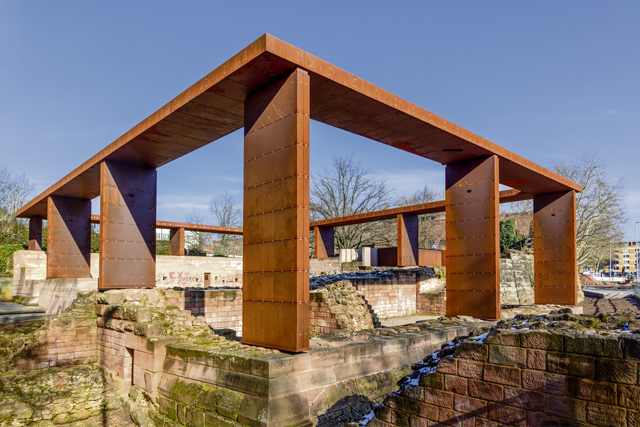
- Ruins of Barbarossaburg
- Fruchthalle, 1846, former market hall, now concert hall
- Villa Kröckel, near Stadtpark
- Various buildings along Richard-Wagner-Strasse/Rudolf-Breitscheid-Strasse, ca. 1900
- Humbergturm, 1900, with a view over the city
- Fish around the town, including KMC Fish at German-American Community Office


