 Twitter
 Facebook
Frankfurt Airport — A centennial flight through time
Most visitors get their first impression of Germany as they descend into Frankfurt International Airport: lush countryside, the Main River, and a glimpse of the city’s skyline. After a seemingly endless taxi to the terminal, a long line at immigration, scurrying to baggage claim amongst the hustle and bustle of one of Europe’s most busy airports, to then pass customs, you will finally be greeted by family, friends or sponsors. Welcome to Frankfurt!
From vineyard landing strip to Rebstock airfield
Aviation’s civilian chapter in Frankfurt began after World War I. In July 1924 the Südwestdeutsche Luftverkehrs AG opened the Rebstock airfield — a simple grass strip set among vineyards, which gave it the name Rebstock (grapevine). Small Junkers twin‑engined aircraft carried mail and passengers to Munich, Stuttgart and Cologne, establishing the early routes and rhythms that would evolve into Germany’s busiest air hub.
Zeppelins, the Weltflughafen and the Hindenburg
By the mid‑1930s Rebstock’s grass fields were no longer adequate. Authorities built a purpose‑designed Flug‑ und Luftschiffhafen Rhein‑Main, complete with a vast Zeppelinhalle. On July 8,1936, the new airport opened as a Weltflughafen (world airport). Lufthansa began fixed‑wing services with Ju 52 trimotors while the Graf Zeppelin and Hindenburg operated from the giant hall. Graf Zeppelin’s regular South Atlantic sailings linked Frankfurt to Rio de Janeiro and Lakehurst, carrying mail and passengers on a tightly coordinated schedule. The era of passenger airships ended abruptly after the Hindenburg disaster in 1937. The Zeppelin hall was repurposed for military use as Europe moved toward war.
War, reconstruction and the Gateway to Europe
After 1945 the airfield was rebuilt under Allied control. U.S. Army engineers converted the site into a major transport hub; Rhein‑Main Air Base was established as Advanced Landing Ground Y‑73 in April 1945. The base hosted fighter and transport squadrons and became known as USAFE’s “Gateway to Europe.”
Frankfurt’s strategic role was cemented during the Berlin Airlift (June 1948–September 1949). With land access to West Berlin cut off, Rhein‑Main served as a primary staging point for C‑54 and C‑47 flights that delivered food and coal to isolated Berliners — a defining moment that underscored the airport’s logistical importance in the early Cold War.
Jet Age expansion and new runways
Commercial traffic surged in the post‑war decades. By 1960 Frankfurt recorded some 2.2 million passengers, and runway use by both military and civilian aircraft became increasingly difficult to coordinate. To enable simultaneous operations, a second parallel runway (07R/25L) was constructed between 1968 and 1972 and opened on Oct. 12,1972. At 4,000 × 60 meters, it allowed true parallel take‑offs and landings for the first time.
Runway lengths and pavements were progressively extended through the 1950s and 1960s to accommodate ever‑larger jets. Continued growth later required additional runways and infrastructure upgrades.
Startbahn West: Environmental protest and social change
The proposal for a third runway, Startbahn West (18 West), ignited one of post‑war Germany’s most intense environmental and civil‑rights conflicts. The airport operator applied for expansion as early as December 1965, but by 1979 organized opposition had coalesced into the Bürgerinitiative gegen die Flughafenerweiterung Rhein‑Main. The dispute transformed a technical approval into a national battleground for the emerging environmental movement, drawing support from the newly formed Greens Party.
When clearing began in 1980, activists built a permanent Hüttendorf (hut village) to block tree‑felling. Over months, squatters, farmers and left‑wing groups staged sit‑ins and nightly demonstrations; clashes with police escalated into street battles. The hut village was forcibly evacuated on Nov. 2, 1981, and mass rallies followed. Startbahn West opened under heavy police protection on April 12, 1984, with Lufthansa’s Airbus “Lüneburg” making the first commercial departure. The delay, security and compensation costs exceeded 225 million Deutsche Marks.
Although large‑scale protests subsided, ongoing demonstrations and a fatal shooting in 1987 led to long‑term noise‑abatement measures. Today, 18 West handles roughly 30 percent of Frankfurt’s flights.
Noise management and operational procedures
To balance growth with community impact, Frankfurt has implemented strict noise and operational controls. Since 2015 the airport enforces seven‑hour noise breaks combining a night curfew. Technical procedures also reduce noise: since 2012 runways support a 3.2° ILS/GBAS approach (instead of the standard 3.0°), keeping aircraft higher for longer over residential areas. RNP (Required Navigation Performance) departure paths and alternating runway use further concentrate traffic over industrial zones and spread noise impacts. Airlines face noise‑related surcharges for louder aircraft, and runway rotations are used to distribute disturbance more evenly.
Terminals, rail links and FRAPORT
Infrastructure continued to expand: Terminal 2 opened in 1994, and a dedicated long‑distance Fernbahnhof next to Terminal 1 began service on May 30, 1999, linking the airport directly to Germany’s rail network. In 2001 Flughafen Frankfurt/Main AG rebranded as FRAPORT AG, which has since grown into a global airport manager operating across four continents.
A fourth, northern runway opened in 2011 (2,800 meters) and is used primarily for landings; drivers on the autobahn from Mainz can see wide‑body jets crossing a bridge as they approach.
Rhein‑Main Transition and the end of an era
For six decades Rhein‑Main Air Base hosted U.S. Military Airlift Command and USAFE operations. In December 1999 the U.S. and German governments agreed on the Rhein‑Main Transition Program, relocating airlift capabilities to Ramstein and Spangdahlem and returning the site to German control. The final USAF aircraft left Sep. 26, 2005, and military control ended on Dec. 30, 2005. Ramstein assumed the “Gateway to Europe” role, and a second southern runway opened for service on Jan. 1, 2007.
A century of Lufthansa
In 2026, Lufthansa celebrates a significant anniversary: on January 6, 1926, the first “Luft Hansa” was founded, and by April 6 of the same year, it had already made its first flight. This anniversary is not only a look back at the history of one of the best-known brands in aviation but also an important step into the future. It is a tribute to the pioneering spirit, innovation, and the connection of people, cultures, and economies that Lufthansa has embodied for a century. The story began with the founding of the first Lufthansa, which was formed from the merger of Junkers Luftverkehr and Deutscher Aero Lloyd.
Innovation and renovation
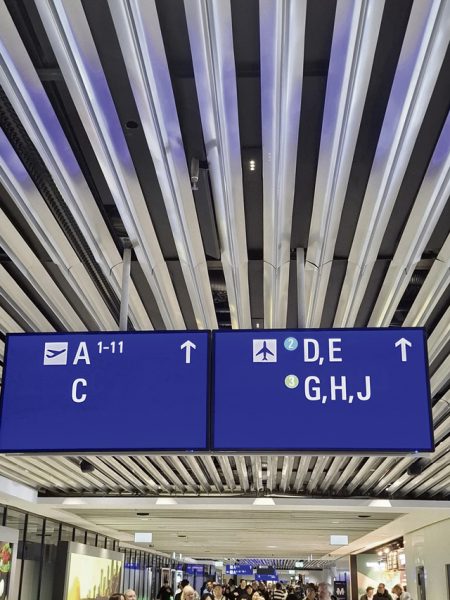
Fraport’s Terminal 3, sited on the former air base grounds (south and opposite Terminals 1 and 2), is slated to open before the summer 2026 season. Designed to handle 19 million passengers across three piers, it will feature a 6,000 m² marketplace with about 65 shops and eateries, daylight‑filled concourses, play zones, work lounges and panoramic apron views. Connectivity will include an eight‑minute people mover (Skyline) from Terminal 1, direct road access, 8,500 parking spaces and bicycle facilities.
Terminal 3 with concourses G, H and J will officially open on April 22. Flight services are expected to commence on April 23, with up to 57 airlines currently operating from Terminal 2, which will then undergo renovation and re-open upon completion.
Airlines will relocate in four phases. Affected carriers include American Airlines, British Airways, Delta Air Lines, Emirates, Qatar Airways, Etihad and Korean Air. For further details and travel advisory see UNTERWEGS.
Safe travels wherever they may lead you and enjoy Frankfurt’s new and innovative travel concept!


