 Twitter
 Facebook
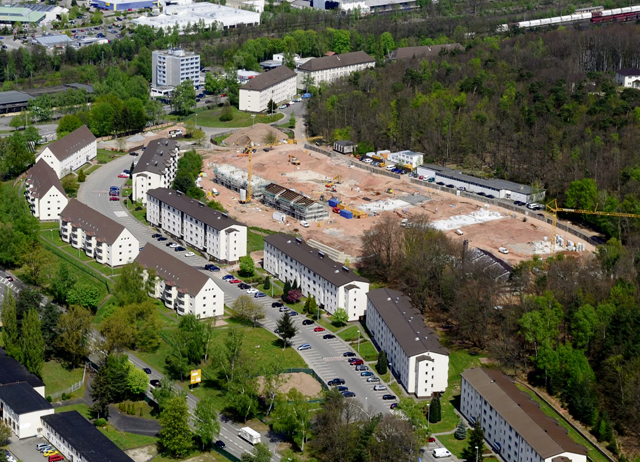
America reaches Kaiserslautern
As we continue to trace Kaiserslautern’s vivid past, today we turn to the last century and contemporary developments, modern chapters that are as central to the city’s identity as Emperor Barbarossa, its market and city rights, and its industrial innovations.
Kaiserslautern was heavily bombed during the last two years of World War II based on its strategic and logistical importance. The single most destructive Allied air raid on the city occurred on Sept. 28, 1944, when heavy bombing, reported as about 909 tons of ordnance that day, left large parts of the built‑up area in ruins and contributed to the city being more than 85 percent destroyed by the end of the war. The railway yards and textile and industrial plants were primary targets, which amplified damage to the urban core.
U.S. military presence in and around Kaiserslautern began with the liberation on March 20, 1945, when U.S. Third Army units entered and secured the city during Operation Undertone. It has since grown into the Kaiserslautern Military Community, shaping the economy, infrastructure and identity of the city and county for eight decades.
Military Bases
During the postwar occupation, U.S. Forces established bases, depots and housing in the region to support NATO and deterrence missions. Ramstein and Sembach Air Bases were founded in the early 1950’s. Army installations such as Pulaski, Rhein Ordnance Barracks and Miesau Depot were established. Other already existing kasernes such as Panzer, Kleber and Daenner, were handed over to U.S. Forces.
Landstuhl Regional Hospital was officially opened in April 1953 along with a housing area. In addition, a small housing area allocated for higher ranking U.S. Army officers was built in Fliegerstrasse, close to downtown Kaiserslautern. In the meantime, the area has been cleared and replaced with modern complexes for the German populace.
Kaiserslautern’s West End
Construction of the Vogelweh Housing area began in the early 1950s. Local histories record summer 1950 as the start date as part of the U.S. military’s postwar stationing and infrastructure build‑out in West Germany. It was built to accommodate service members and their families assigned to Kaiserslautern and nearby installations, Vogelweh was planned as a self‑contained community with schools and kindergartens, dining facilities, AFN radio and television, a commissary and Base Exchange, plus recreational centers and community spaces.
Initially dominated by large multi‑story housing complexes, the area saw phased upgrades over the decades. Mid‑1980s renovations added larger wet‑cell bathrooms, and security measures after 9/11 enclosed what had been an open neighborhood. In 2004 a teardown-and‑new‑build program replaced many older blocks with modern townhouses, giving residents more comfort and living space and further shaping Vogelweh into a permanent, family‑oriented installation.
The 2004 program was part of a larger plan to build 855 new townhouses across Ramstein, Vogelweh and Landstuhl; the new two‑story units were designed as duplexes/triplexes/ quads, primarily three‑ and four‑bedroom homes with family rooms, garages and fenced yards. According to a rough estimate, more than 35,000 families have resided in Vogelweh housing since the 1950’s. For more information regarding construction and upgrade, visit KA article from 2004: https://www.kaiserslauternamerican.com/new-kmc-housing-construction-begins/
Kaiserslautern Military Community
The original “Creek Swap Agreement” in 1975 gave rise to the term KMC and formally created the Kaiserslautern Military Community to coordinate Army and Air Force facilities across the region. The Creek Swap memorandum stipulated that USAFE would appoint an Air Force general to represent U.S. interests to the German city government and law‑enforcement authorities. A 1993 revision narrowed the language to state that USAFE would have the lead for the KMC, and the 86th Airlift Wing Commander was named the Community Commander. In December 2010 responsibility shifted to the Third Air Force commander; the position is currently held by Major General Paul D. Moga.
Rock ‘n’ Roll and Ice Cream
The U.S. military presence around Kaiserslautern reshaped everyday civilian life. In the early 1950s rock ’n’ roll rolled in with Coca‑Cola, hamburgers and American ice cream, and locals embraced the new tastes and sounds. Bars and dance halls popped up across the city, weekend parties grew wilder, and Steinstrasse, from Martinsplatz to Mainzertor, eventually earned an “off‑limits” reputation because of the raucous crowds.
Kaiserslautern’s civilians profited from the U.S. presence, which reached up to 88,000 Americans in the late 1980’s. With so many service members and families in the area, local residents found steady customers and new opportunities. When housing ran short, German families opened their doors, renting to Americans, making friends with neighbors and landlords, and weaving new social ties. Shops and service businesses sprang up to meet demand, selling everything from cars and furniture to household goods, while supermarkets thrived moving both German staples and American favorites. Hospitality and leisure boomed. Gasthäuser, restaurants, bars, and hotels raced to cater to American tastes, lifting the local economy and helping rebuild a region still recovering from war.
Weddings, children and zugereischde
Families and long‑term ties followed, as many service members married local partners.
Up to 4,000 military and civilian retirees are known to have opted to stay in the local area and are sometimes referred to as “zugereischde” in Palatinate dialect, meaning new resident. In addition, since 1953 more than 58,000 babies of U.S. or German‑American parentage were born in Landstuhl, including a few who later became public figures such as LeVar Burton (Star Wars), Rob Kelly Thomas (Match Box Twenty) and Reggie Williams (National Football League).
On the other hand, over 450 infants that passed shortly after birth were laid to rest at the Kindergraves site at Kaiserslautern main cemetery and are commemorated in an annual ceremony.
Economic Impact
The economic impact of the Kaiserslautern Military Community is substantial. Its annual contribution to the local economy is estimated at $2.26 billion, driven primarily by three factors: KMC payroll, expenditures on construction, services, and materials, and the estimated value of jobs created. The U.S. presence, roughly 50,000 Americans living and working in the region, makes the West Palatinate home to the largest American military community outside the United States, and that scale of activity underpins local businesses, public revenues, and employment.
To wrap this chapter of history up: The U.S. military presence since 1945 has transformed Kaiserslautern from a war-torn city into a transatlantic hub whose economy, infrastructure and identity remain deeply intertwined with American Forces. Some residents of the Westpfalz region lovingly refer to the area as “Klein Amerika”!
To celebrate its 750th anniversary, Kaiserslautern invites its American friends to join special German‑American concerts with the USAREUR/AFRICA and USAFE/AFAFRICA Bands in the city center on May 8 and 9. For details see UNTERWEGS


