 Twitter
 Facebook
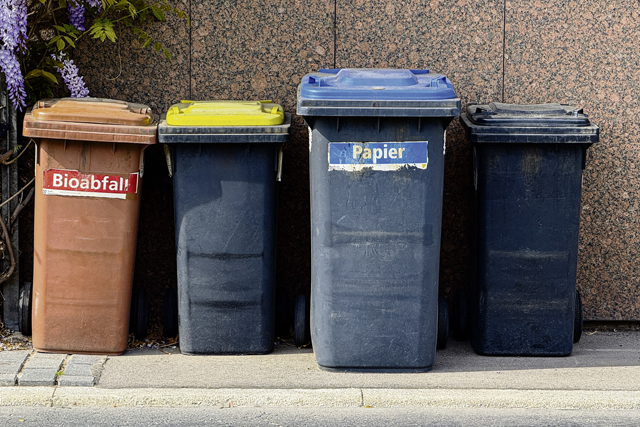
If you’ve been in Germany for a while, you might have heard about the Germans’ obsession with recycling and waste separation. Germany uses a color-coded waste system to ensure that as much material is recycled as possible.
The first recycling efforts were made in 1974 in Hanover, when containers for waste glass were set up. In the years since, recycling and waste separation programs were introduced across the country and have become a resounding success.
Over 70 percent of plastic packaging was recycled in 2024, and according to the German Ecological Institute, up to four million tons of secondary materials could be reclaimed by recycling every year.
But how does it work? What do I throw in each bin?
Germany divides waste up into the following distinct categories, and each category has assigned a color.
- Composites/ Plastics (Yellow)
- Paper/ Cardboard (Blue)
- Biological waste (Brown)
- General waste (Black)
- Glass
Unfortunately, these colors are not the same across Germany, with some variations existing between different communities. Your community usually issues a small booklet informing you of waste collection times. If you are unsure as to what color your type of waste has, it can always be helpful to refer to that booklet.
Separating your waste makes life easier for the people working further down the recycling process, but it also means that as much material as possible is reclaimed. It is, however, not always as straight-forward as it seems. Below are some common mistakes that even the recycling-savvy Germans regularly make.
Yogurt cups in general waste:
Yogurt cups are often comprised of three separate components: the cup, the lid and the label. To correctly dispose of the container your delicious dairy snack came in, remove the aluminum lid from the plastic cup and throw both into the composites/ plastic bin (yellow). Then remove the cardboard label, they usually have a perforation to make them easy to tear off, and throw that into the (blue) paper bin.
Dirty Containers:
Always empty your containers before throwing them into the composites/ plastics bin. You do not have to rinse them, just clean out any leftover food out of your to-go boxes and squeeze that last drop of lotion out of the tube.
Kitchen towels/tissues:
You might be inclined to throw your used tissue or kitchen towel into the paper bin, as it is, well, paper. They are, however, a of a type of paper fiber that cannot be easily recycled. Add to that, that they are generally not very clean when you throw them away, they become a prime candidate for the general waste bin, which is where they belong.
Glass:
It is a superhero amongst materials as it can be recycled infinitely. You can dispose of your waste glass at the containers you might have seen dotted around your community. Simply throw your empty jars into the corresponding color container:
- White/ clear ‡ White
- Brown ‡ Brown
- Green ‡ Green
- Everything else ‡ Green
You can throw the lids in with the glass but do not leave glass standing beside the containers if it is full. It can hurt animals and people and constitutes an administrative fine.
Hopefully this quick guide will help you navigate the complicated world of German waste separation. If you have more questions about this or anything else about life in Germany, our GACO team is here to help!
Deutsch-Amerikanisches Bürgerbüro
German-American Community Office
67657 Kaiserslautern, Lauterstr. 2
Phone: 0631 363-3010
Email: info@gaco-kl.de
URL: www.gaco-kl.de
Office Hours: Mon, Tue, Wed, Fri 9 a.m. – 1 p.m., Thu 2 p.m. – 6 p.m.


