 Twitter
 Facebook
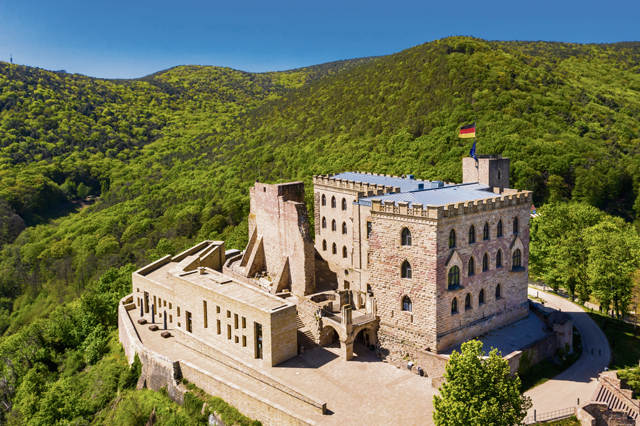
As the United States marks its 250th anniversary, the small town of Hambach near Neustadt an der Weinstrasse celebrates its own milestone: Hambach Castle, set atop a hill and surrounded by vineyards, hosted the Hambacher Fest just 56 years after the American Declaration of Independence. On May 27, 1832, that gathering — often regarded as the “Cradle of German Democracy” — saw the first raising of the black, red, and gold flag.
Many in the Kaiserslautern Military Community may already be familiar with the charm of Neustadt an der Weinstrasse: narrow alleys and half-timbered medieval houses, a broad market square anchored by St. Ägidius Church, and sunlit courtyards perfect for enjoying a glass of local wine. Hambach, a neighborhood of Neustadt located directly along the Weinstrasse, holds an annual festival to commemorate a landmark moment in German and European history.
In May 1832 about 30,000 people gathered on the mountain to advocate for a rule of law, national unity, civil liberties, and European solidarity. The event that drew men and women of all classes demanding freedom of expression, freedom of the press and freedom of association became known as the Hambach Festival and was the first step on a long road to the development of German and European democracy.
Road to Democracy
The year 1816 brought about significant territorial changes to (today’s) Rheinland-Pfalz region and was transferred to the King of Bavaria. At that time, Germany was split into a number of smaller kingdoms or duchies, and people lacked a sense of unity.
Failed harvests threatening the existence of farmers and wine growers in a mainly agricultural area plus customs regulations for exports (to homeland Bavaria) eventually led to unrest by the 1830s. In addition, political, economic and widespread social discontent contributed to the great mobilization of the Hambach Festival.
Critical opinions and political demands were censored, and journalists and lawyers called for a united German state and constitution. The most important initiative that led to the Hambach Festival was the “German Fatherland Association in Support of Free Press” with its two main goals national unity and freedom of the press.
The association was founded in January 1832 and quickly gained momentum. Friedrich Schüler, head of the liberal opposition in Bavarian parliament, was successful in limiting Bavaria’s policy of censorship. Journalist Jakob Siebenpfeiffer and others joined the association, which quickly grew to 5,000 members, many of them from Neustadt.
Originally a celebration in honor of the Bavarian constitution was planned at Hambach Castle on May 26, 1832. On short notice Siebenpfeiffer rededicated the event and instead spread a public petition and extended an invitation to a “Festival of Hope” on May 27, intended to “shake off inner and outer violence and strive for lawful freedom and German national dignity.”
The petition was signed by 32 citizens of Neustadt who organized the festival. The Bavarian government’s attempt to stop the festival with a ban backlashed due to the journalistic outcry of the liberal-democratic opposition and unintentionally even led to further mobilization of citizen discontent with the political, economic and social situation.
Siebenpfeiffer explicitly invited and encouraged women to actively participate in the event, something that was by no means a matter of course at the time. The invitation read: “German women and maidens, whose political disregard in the European order is a mistake and a stain, adorn and enliven the gathering with your presence!”
Many women accepted the invitation and for most of them, it would have been the first time they took part in a political gathering. The Hambach Festival thus also marks an important step at the start of the long road to politically mobilizing women in Germany.
Black, red, gold
The festival turned out to be more of a colorful folk fest than a political gathering. Thousands accepted the invitation, there were stalls and carts selling bread, sausage, beer and wine, and even carousels were set up for three lively days.
A procession started at the market square in Neustadt in the morning and moved up the hill with the participants shouting “Hinauf, hinauf auf’s Schloss!” A Neustadt civil guard headed the procession and was flanked by a large group of women. Students with pamphlets demanding democracy mingled in the crowd, while Johann Philipp Abresch, a businessman from Neustadt, carried a very special flag and hoisted it on the tower of the castle ruins for all to see.
The flag was evenly colored with stripes in black, red and gold, and had an inscription “Deutschland’s Wiedergeburt” (Germany’s rebirth) stitched in the middle red strip. This original flag can be seen at the permanent exhibit “Up, up to the Castle!” and to present these colors stand for a free, democratic and unified Germany.
The Hambach Festival brought people together from both near and far. Most came from the surrounding area, but many also came from Bavaria, Württemberg, the Rhine Province, Poland, and France. They wanted the creation of a nation state, as well as mutual understanding between European nations.
There were twenty speakers throughout the event and Johann Wirth ended his with this final note: “Cheers! Three cheers for the Confederate of Europe!” He was expressing the solidarity of all peoples who fought for their freedom and national independence. This may have been the seed that implanted the idea of a unified Europe and creation of the European Union 160 years later. The European Union currently has 27 member nations and 448 million inhabitants.
Hambach Castle
The vibrant site and magnificent castle that marks the history of democracy is open to visitors and features the permanent exhibit “Up, up to the Castle!,” a colorful Lego scene and interactive elements to explore in depth.
An event program throughout the year features political discussions, classical concerts, cabaret performances, and plays for children and adults — offering as much cultural entertainment as the spirited debates. Visitors can wander the castle garden, relax on the Mediterranean-style panorama terrace, or dine at Restaurant 1832 to explore and enjoy. The garden, terrace, restaurant, and castle are fully accessible.
The annual Hambacher Musikfest with classical and chamber music will take place on June 3 and 7 in the castle’s concert hall.
The festival “Schwarz-Rot-Gold” — Three Days of Freedom, Unity, Brotherhood — directly in Hambach is scheduled for June 12 – 14. Hambach wineries, clubs, restaurateurs, and artists will open their charming courtyards, cellars, parlors, and gardens and invite you to linger with music, exhibitions, wine, and regional delicacies, and theater for young and old. Late Saturday evening, special accent illumination will be switched on, casting the scene in an entirely new light.
Whether it’s history, a fantastic view or a sip of Palatinate wine, Hambach and its castle are always worth a visit!


