 Twitter
 Facebook
If you’ve driven through Otterberg, you’ve likely noticed the handsome half-timbered houses along the main street—but you might also have wondered why a town of this size has such an enormous church, or why a place of roughly 6,000 people bears the sign “Wallonenstadt Otterberg,” marking it as a city.
Otterberg’s past explains both. In 1145 Cistercian monks founded an abbey here. The Cistercians preferred sites in river valleys or marshy terrain, and, as a sign of their humility and purity, they chose to build the monastery beside the Otterbach stream.
The large monastic church, originally part of the Cistercian monastery, was constructed between 1168 and 1254. It dominates the townscape and is the largest sacred building in its original form in the state of Rheinland-Pfalz, only a few square meters smaller than the cathedral in Speyer, which has undergone several restorations after repeated damage.
After centuries of monastic life, the church was abandoned and gradually fell into ruin following the Protestant Reformation in the 16th century. The City of Otterberg also offers Time Travel tours that will let you dive into its history with virtual reality glasses. https://www.otterbach-otterberg.de/tourismus-freizeit/gaestefuehrungen/time-travel/
Wallonenstadt Otterberg
In 1579 Palatine Count Johann Casimir permitted religious refugees from the Spanish Netherlands — exiled Calvinists known as Walloons — to settle in the abandoned monastery. His decree allowed parts of the complex to be converted into housing while protecting key structures, including the church, the chapter house, and the abbey house.
About 400 people arrived at first, but the industrious settlement expanded quickly. By 1581 Otterberg’s population had grown to roughly 1,600 and the town was granted city rights, which it still retains today.
The Walloons, mainly from the French speaking part of Belgium, were proficient cloth makers and tanners, blacksmiths, carpenters and skilled craftsmen. Many buildings in the historic district were built by these skilled workers, such as the oldest house, the Ferkelsche Haus, which was built in 1606, the Alte Apotheke (pharmacy), which was built in 1608, and the Blaues Haus, which was built in 1612.
Edifices built in the 17th and 18th centuries can still be found on the main street today with the Walloons and their craftsmanship playing a significant role in shaping the character of Otterberg. The square in front of the church features a granite sculpture of historic life and times in the city and the neighboring Altstadt is great for strolling and dipping into the age of the Walloons.
In 1708 shared use of the church by Protestants and Catholics sparked conflicts. To resolve them, a dividing wall was erected inside: Catholics used the transept while Protestants worshipped in the nave. The partition remained until 1979, when it was taken down and the church returned to joint use by both denominations.
Behind the church is a fragrant herb garden, open to visitors on summer weekends. A smaller sister church, also built by the Cistercians, is the Klosterkirche in nearby Enkenbach.
The church offers grandiose classical concerts throughout the seasons. An evening marked by youthful voices and great a cappella music across the centuries – the Youth Concert Choir of the CHORAKADEMIE at the Konzerthaus Dortmund e.V. invites you to its concert on June 21.
Long live the Spring Queen!
Since the mid-18th century, the Spring Festival has been celebrated in Otterberg every two years. In the shadow of the monumental building of the Abbey Church, the people of Otterberg meet with their guests from near and far for a joyful festival weekend. The festival is held on Saturday, June 13 at 7:00 p.m. by the mayor and the Spring Queen on the square in front of the Abbey Church. With entertainment music provided by the Otterberg “Harmony” Music Association, the enthronement of the queen with her entourage is celebrated in a merry gathering. From around 8:30 p.m., the stage belongs to a well-known live band from the region.
But beware, at 6 a.m. on Sunday morning, citizens of Otterberg are awakened by loud resounding cannon shots. This is at the same time the starting signal for the music club “Harmonie,” which parades through town for a musical wake-up call and followed by an invitation for a tasty break. Everyone is warmly invited to march through the streets early in the morning.
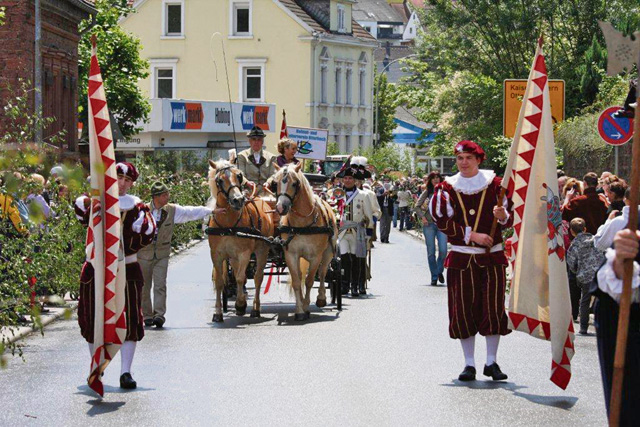
The festival’s highlight is a historic, colorful parade at 1:00 p.m. along the decorated main street. Over 1,000 participants bring Otterberg’s past to life in period costumes, led by lively fanfare bands. The procession features Cistercian monks, Walloons, Huguenots, and the town’s night watchman, followed by the Spring Queen in a festooned carriage drawn by stately horses and her court. The original city mayor, Lambert la Croix, who presided when Otterberg received its city rights in 1581, is also represented.
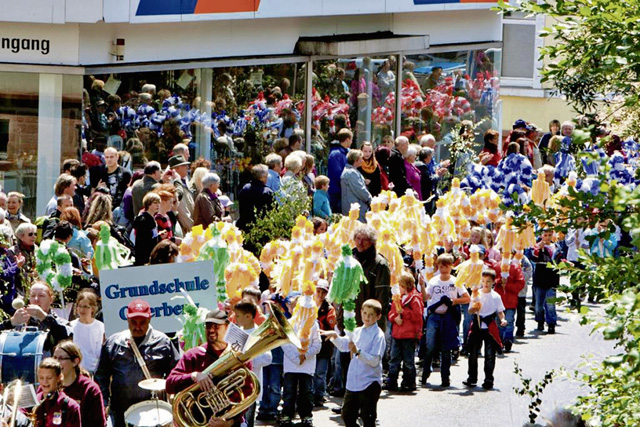
Kindergartens and all elementary schools with colorful wreaths and sticks will join the procession with hundreds of students. Local clubs and businesses will enrich the colorful scene with decorated floats and themed walking groups.
After the parade, all guests walk together to the forest festival location, which is about 3 kilometers outside the town on the country road to Höringen. Families celebrate in the forest, with music provided by various bands from neighboring communities, and local caterers will take care of the guests’ physical well-being. The popular pony rides will take place again, and in any case, all children will receive free pretzels from the Spring Queen and the city council. For more information visit: www.otterbach-otterberg.de
Don’t miss out on this fun-filled weekend with insights into Otterberg’s colorful history!


