 Twitter
 Facebook
In 1983, President Ronald Reagan designated October 6 as German-American Day to commemorate the 300th anniversary of Germantown, Pennsylvania—the first German settlement in the United States. Later, in August 1987, he signed Proclamation No. 5719, encouraging Americans to honor the occasion through fitting ceremonies and activities.
In early October of this year, Minister President of Rheinland-Pfalz, Alexander Schweitzer, traveled to Washington, D.C. for high-level discussions on a range of topics, including meetings at the Pentagon. A key focus of the visit was the presence of U.S. military forces in Rheinland-Pfalz, particularly in locations such as the Kaiserslautern Military Community, Baumholder, and Spangdahlem.
Did you know that Homburg, a small city just down A6 towards Saarbrücken or Zweibrücken, plays a decisive role in German-American relations and has a chest full of hidden historical treasures?
Homburg is famous for one of the largest breweries in Germany, its caves “Schlossberghöhlen,” and its castle ruins. It hosts the largest flea market in the region and a restructured Roman village can be explored at nearby village Schwarzenacker. However, not many know that former residents, soldiers and influential emigrants from Homburg also shaped the history of the United States centuries ago.
An estimated 17 percent of Americans are descendants of Germans, many of whom were from the Saarland and an estimated 300,000 Palatinates also emigrated to the United States over three centuries. Some of these emigrants became rather famous, such as David Weber a pioneer of the wild west in the late 1800s.
During a stroll you can set out on a discovery tour of Homburg to learn a few fun facts and and gain interesting insights. For example, George Washington’s aide-de-camp and famous painter John Trumbull was the first American tourist who was known by name in Saarland.
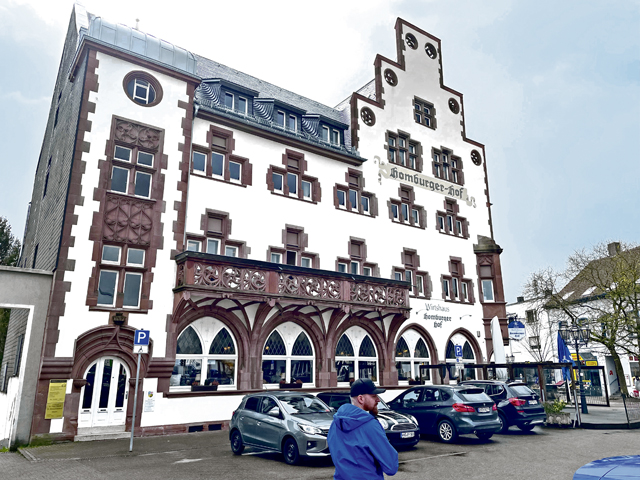
A historical inn (now Homburger Hof) built in 1906 can be the start of the tour at the “Rondell.” At the beginning of March 1945 the inn served as the U.S. Army Thunderbird Division headquarters. Later in July when French troops followed, they also used the inn as their headquarters and officers’ club. Kaiserstrasse, initially built by Napoleon, was used by both armies to liberate Kaiserslautern.
Strolling through Homburg’s old town you can catch a glimpse of the same architecture of first houses in New York when it was still named Nieuw Amsterdam.
The legendary German Royal French Infantry Royal Deux-Ponts regiment is closely connected with Homburg and America’s history. In 1776, the 13 states of North America revolted against the British crown under George Washington’s command. The Royal Deux Ponts regiment recruited soldiers in or near Homburg and was sent overseas in 1780. During the Battle of Yorktown October 14, 1781, the regiment captured the important entrenchment “Redoute 9” forcing supreme commander Lord Cornwallis to surrender five days later. After the final British surrender in 1783, negotiations held in Yorktown between the enemy parties resulted in the United States finally being granted independence.
As thousands of soldiers returned to Germany in 1783, the Royal Deux-Ponts also brought with them the ideas of the American Revolution with far reaching consequences. Ten years later Louis XVI of France was executed, Karl II August fled from the advancing French revolutionary soldiers and his castle Karlsberg near Homburg went up in flames.
In 1786 John Trumbull visited the region and the impressions that he gained during his journey were written down in his autobiography, also complimenting the delicious potato salad in Saarland.
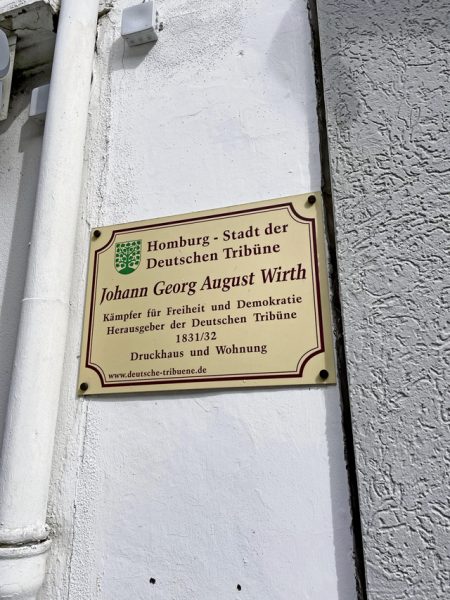
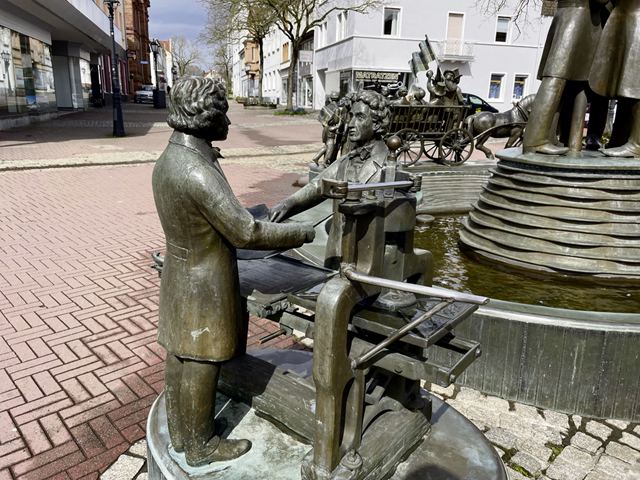
A further house was inhabited by Johann Georg August Wirth who published the legendary “Deutsche Tribüne,” a democratic newspaper in 1832. Ludwig August Wollenweber who supported him was forced to flee and seek his fortune in the United States as many other democratic minded Germans, and founded the “Liberal,” a daily newspaper in Philadelphia. He later took over “The Democrat” which became the leading German paper of the East coast capital. In addition, he was engaged as correspondent for German newspapers and normally wrote in high German, but occasionally used Westrich dialect, very similar to Pennsylvanian Dutch.
“My home is where freedom is” was the slogan of thousands of emigrants that left Germany and found a new home and political freedom in the United States after the Revolution in 1848 when citizens stood up against Bavarian rule. Hinting at the March Revolution, they were called the “Forty Eighters” with Carl Schurz, who had lived in Homburg, being the most prominent one among them. In 1852 he emigrated to the United States and became a strong supporter of the Republican Party, contributing to Abraham Lincoln winning the election by recruiting Germans to vote for him. Later he fought in the Civil War as Union general, along with thousands of other German soldiers, and was appointed Secretary of the Interior by President Hayes in 1877. When Carl Schurz died in New York in 1906, it was none other than Mark Twain who praised this significant “Forty-Eighter” posthumously.
Further Germans from the region had a strong influence on pre-civil war history. Thomas Nast emigrated in 1846 and quickly became a prominent political cartoonist and engaged himself in support of the Union. Abraham Lincoln described him as being the best “advertising medium” with his caricatures. Nast became an adamant supporter of civil rights and also created the two political symbols, a donkey for the Democrats and an elephant for the Republicans. The well-known Uncle Sam caricature stems from his pen and during the holiday season he would draw figures and created the first illustration of Santa Claus, inspired by St. Nikolaus from home in Germany.
Another Jewish-German emigrant Levi Strauss from Bavaria designed the first pair of “blue jeans,” initially intended as clothes built to endure anything. The denim pants quickly gained popularity and Strauss created a lifestyle trend for generations to come.
You might also discover a small plaque located at the former parsonage with the inscription “Carl David Weber,” who lived there from 1815 – 1836. In that year he emigrated to America and stayed in New Orleans for a short time. Later he went to St. Louis where he heard about a group of people heading west. After six months and close to starvation, the group reached California which was then still part of Mexico. He changed his name to “Don Carlos Maria Weber” and purchased a huge piece of land in 1847. The houses, stable and rodeo places were meant to attract settlers and in 1848 Mexico was forced to cede California and the gold fever set in. First named Tuleburg, he later renamed the town to Stockton, which later flourished as a significant industrial and cultural capital. Weber died in his own town in 1881 and is remembered to this day.
A further stop on the discovery tour is at the former town hall at the market square. Georg Müller, a soldier born in Homburg and member of the African Corps during World War II was a prisoner of war and transferred to Kentucky, where he discovered a copy of the New York Times Magazine, edition April 15, 1945. He was astonished to see a photo of weary civilians and determined U.S. soldiers standing on the steps of the building in his hometown, claiming “We take over!” He brought back the original magazine that is kept in the Homburg city archives.
There are many more unsung heroes, poets and pioneers that came from Homburg or the region. The Deutsch-Amerikanischer Freundeskreis Saarpfalz holds strong ties with Henrico County, Virginia, and organizes annual German-American events. Use the opportunity to explore and discover American traces for yourself wandering through the town.


