 Twitter
 Facebook
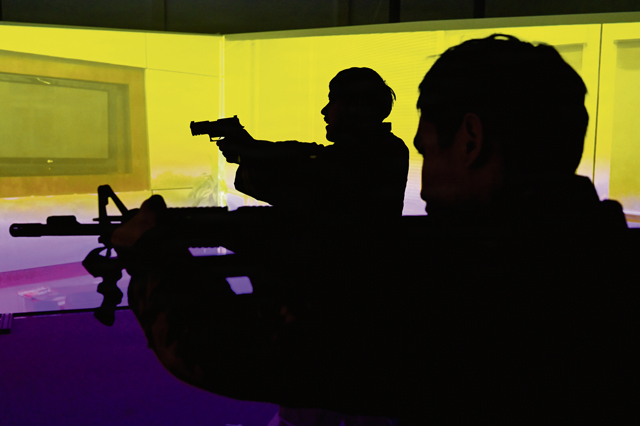
Music echoed down the hall leading to the combatives training room where new Airmen assigned to the 86th Security Forces Squadron watched Staff Sgts. Kristen Wurtz and Victoria Kelley, 446th Security Forces Squadron Phoenix Raven team members, demonstrate close-quarters defense tactics at Ramstein Air Base, Nov. 24-25.
The Airmen were focused and motivated, as the two Raven instructors recalibrated their positioning and guided Airmen through each technique and movement.
Airmen rolled through the drills, testing their control and use of different angles, as Kelley and Wurtz moved between groups and corrected the Airmens’ hand and leg placements. They ensured that they were shaping Defenders who can respond at a moment’s notice and react with precision and skill during unpredictable, life or death situations.
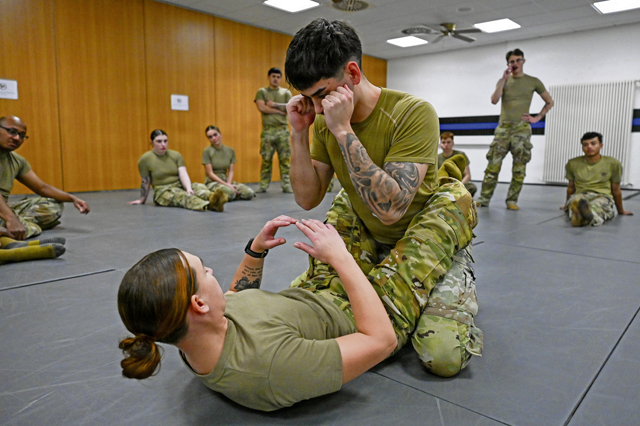
“As a Phoenix Raven, we are attached to the aircrews of mobility aircraft to provide physical security for U.S. resources in environments with little to no security,” Kelley said. “As security forces, training combatives and batons is essential. We want to be proficient with our less than lethal weapon and being functionally fit is a crucial aspect to this sort of training.”
Phoenix Ravens are an elite security forces team that undergo intense specialized training to carry out missions that demand a higher level of physical strength, mental grit and tactical capability. Only a select few get to attend and graduate from the schoolhouse at Joint Base McGuire-Dix-Lakehurst, New Jersey, making the Raven tab rare and well-respected.
“The Ravens help improve the training because they have extra skills and knowledge regular Defenders like myself may not have,” said Senior Airman Alexandro Ochoa, 86th Security Forces Squadron training instructor. “Although I’ve done Raven training, the actual Raven tab really inspires and motivates Airmen when they see it, especially new Airmen.”
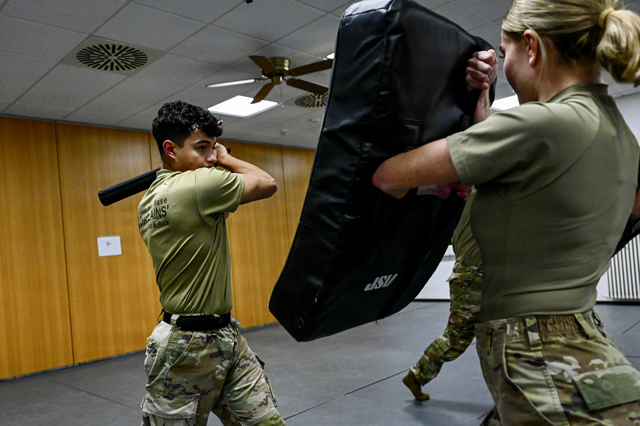
Sharing their knowledge drives the culture of fitness that builds a mission-ready and lethal force at Ramstein by equipping Airmen with the foundational skills necessary for such high stakes security operations.
Understanding the physical techniques available to Defenders was only one key component of the training, the other was knowing when and how to use them.
“I want the Airmen to understand the capabilities of less than lethal weapons while building confidence through repetition,” Kelley said. “Understanding the weight of lethal and non-lethal weapons creates the sharpest security forces members.”
Ochoa added that working alongside the Ravens not only fostered better Defenders, but also elevated his own method of teaching as a training instructor.
“This training is different from the usual because when it comes to phase training we have our own way of instructing, but with the Ravens, they are able to not only teach the phase members but also myself,” Ochoa said. “I am learning things that I can use in the future to instruct phase members and make myself a better, and more skilled, instructor.”
The instructors underscored the importance of attention-to-detail during the training, as it may one day determine the outcome of a real-world encounter.
“I hope new Airmen take all of the information from the Ravens that they can,” Ochoa said. “These skills Ravens have and are willing to share really could save one of their lives or someone else’s life one day.”


