 Twitter
 Facebook
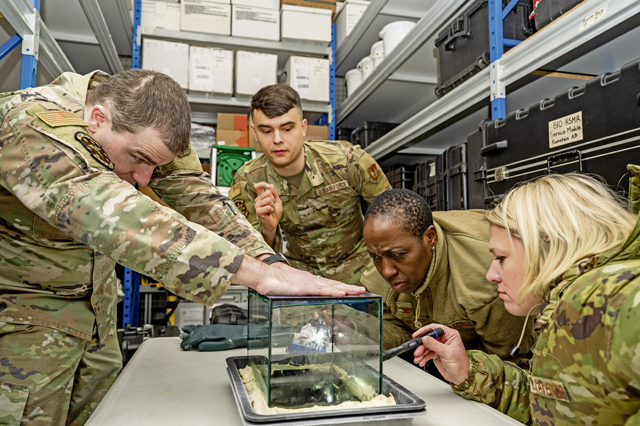
The room is dim except for a soft glow of light from a flashlight pressed against the condensated glass of the tank. A faint shimmer bounces across the surface as cold vapors gather, swirling like fog lifting off the surface. Almost mistakable to the naked eye, thin white streaks coming together in a dance through the mist, tiny bursts of motion that disappear as quickly as they appear.
And for the first time ever constructed at Ramstein in November, those fingerprints are finally visible.
Standing around the tank, Airmen from the 86th Medical Group bioenvironmental engineering flight lean closer, gazing at the traces of subatomic particles from a safely contained radioactive source. Engineers create these wisps of radiated particles traditionally from a laboratory environment, but ingenuity allowed these Airmen to showcase these hazardous vapors in a practical environment.
“The cloud chamber helps visualize radiation since a lot of people are scared of it once they hear the word,” said Senior Airman Brandon Wagner, 86th Operational Medical Readiness Squadron bioenvironmental engineering technician.
Wagner was the sole Airman that initiated and spearheaded the build of the cloud chamber tank to better educate his fellow wingmen. “I think it helps visualize and demystify radiation by bringing a visual aid to personnel and civilians.” Wagner, bringing a training grounded in ionizing radiation, expands upon concepts that have the potential to bolster mission readiness and crisis response.
The project began as a simple idea: help Airmen understand radiation, not as an obscure piece of information found in monotonous training slides, but as a real and observable phenomenon, Wagner said. “Radiation is part of our world. When you see the traces it leaves behind, you begin to understand it in a completely different way.” Cloud chambers are typically constructed within controlled laboratories or university research facilities. “I have never heard of it happening outside a laboratory environment,” said Tech. Sgt. Alex Shuttleworth, 86th Operational Medical Readiness Squadron bioenvironmental flight noncommissioned officer in charge. “I asked a couple of my friends and they have never built one before.” But Wagner, who describes himself proudly as a “radiation nerd,” had been eager to build one since learning about them from a previous mentor.
For the bioenvironmental engineering flight, the chamber is a scientific curiosity. Radiation is a core part of their mission. “It helps bring awareness to our new Airmen because it is a difficult subject to learn about,” Wagner said. “Being able to see first hand what radiation is can be the first step in understanding how to give health risks to commanders.” Inside the chamber, Airmen can distinguish short, delicate trails left by alpha, beta, and x-ray particles, the residuals of space curiosities from supernovas and distant galaxies.
“The main ones you’ll see in the tank are called muons,” Shuttleworth said. “They shoot down from cosmic rays hitting the atmosphere. And then we have our sources that emit alpha and x-rays. Being able to see them helps you visualize and understand the whole concept of radiation.”
While the chamber is a simple device, its impact is far-reaching.
“If we ever respond to a radiation incident such as a dirty bomb, a radiological release, even something much worse, it helps build our confidence, and then our commander’s confidence, that we know what we’re talking about,” Shuttleworth explained. Without laboratory-grade sources, the team used small, safe check sources to avoid creating any hazardous conditions. “We’re not going to create a radioactive incident inside of Germany, so we’re using what we have, and it still teaches us to understand radiation better,” he said.
The chamber also has the potential to support other first responders, including 786th Civil Engineering Squadron Emergency Management, 786th CES Fire Department and Emergency Services, and 86th Security Forces Squadron, helping to create a shared baseline understanding of radiological hazards for those serving in the frontlines of base defense.
As the fog in the chamber rolls and particles leave their fleeting trails, the Airmen watch fumes create outlines of science being brought in a practical environment. For these Airmen, it’s more than a scientific display, it’s a new way of seeing the mission. “It’s the first step in understanding,” Shuttleworth remarked. He concurred that once you see radiation, the team’s understanding expands, penetrating visible to tangible, ensuring trusted counsel and acute protection of personnel.


