 Twitter
 Facebook
Story & photo by
Capt. Amber R. Kelly-Herard
435th Air Ground Operations Wing
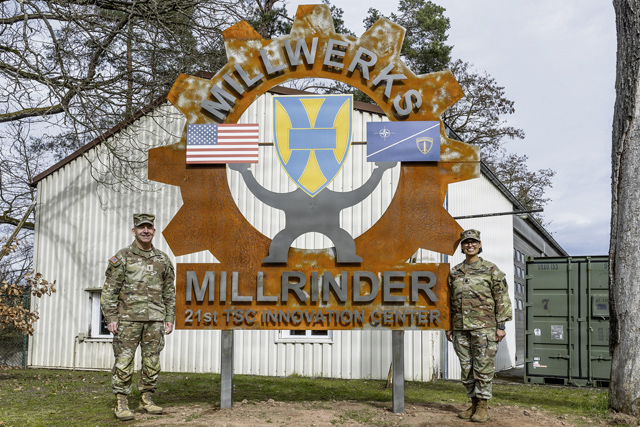
Minutes after U.S. Army Europe and Africa leaders, alongside 21st Theaters Sustainment Command leaders, cut a ceremonial ribbon at the 21st TSC Millrinder innovation center, Mar. 13 at Panzer Kaserne, a thrum of industrial sounds began emanating from a supply warehouse recently converted into one of the most technologically advanced sustainment facilities and the first in the U.S. catalog in Europe.
The grand opening event featured demonstrations of the center’s advanced manufacturing capabilities and opportunities to engage with Soldiers and experts driving innovation. The Millrinder Innovation Center is not only a U.S. Army asset, but also a collaborative hub for NATO allies, host nations, and private industry, strengthening partnerships and ensuring interoperability across the European theater.
“This is going to be a game-changer for us as sustainers in our ability to fix forward and innovate at the speed of war and produce at the point of need,” said Maj. Gen. Michael Lalor, the 21st TSC commanding general.
The Innovation Center is a partnership with U.S. Army Combat Capabilities Development Command Army Research Laboratory and is built on three pillars: Innovation, Training, and Readiness. Readiness means Soldiers having what they need to accomplish the mission by closing supply chain gaps, restoring combat power faster, and empowering innovation at the speed of war by leveraging the full capability of advanced manufacturing.
“This is about driving a culture of innovation, coupled with great material and equipment, and how we are going to put the culture of innovation with that advanced manufacturing equipment to drive readiness effects through the theater,” Lalor added. “This facility will also give us a whole network, end-to-end across echelons, west to east, to enable us to fix forward and supply our warfighters with what they need while solving problems in this theater,” said Lalor.
The facility is designed to enable the U.S. Army to produce the materials it needs at scale and depth to fill supply chain gaps.
To harness ideas and create effects that will translate into more lethality throughout Europe, the innovation lab is outfitted with advanced manufacturing technology, including multiple types of 3D printers, 3D scanners, robotics systems, sewing machines, and metal cutting machines designed to create a wide range of products identified by Soldiers in the field as items needed in the field. Soldiers can submit innovation ideas through a web-based submission portal https://21sttsc.soldierinnovation.com/sMain/landing or through their Brigade innovation leader.
“If a Soldier identifies a need in the field for a part that currently exists, we can reproduce it and get it to them in a matter of days for a fraction of the usual cost,” said Maj. Ron White, the 21st TSC’s innovation chief. “If a Soldier submits an innovative idea, like a vehicle part that is currently not in our network catalog, we can work with that Soldier to design and test the idea. This process is designed to encourage innovation and also circumvent the slow and expensive bureaucratic process that is often associated with new ideas. This can save the Army time and money,” said White.
Soldiers whose innovation proposal submissions are selected for development may travel to the facility to receive hands-on training to learn how to operate the lab’s machines and will collaborate with on-site civilian industry experts or allied trades professionals to develop and refine their solutions in a classroom equipped with advanced manufacturing workstations.


