 Twitter
 Facebook
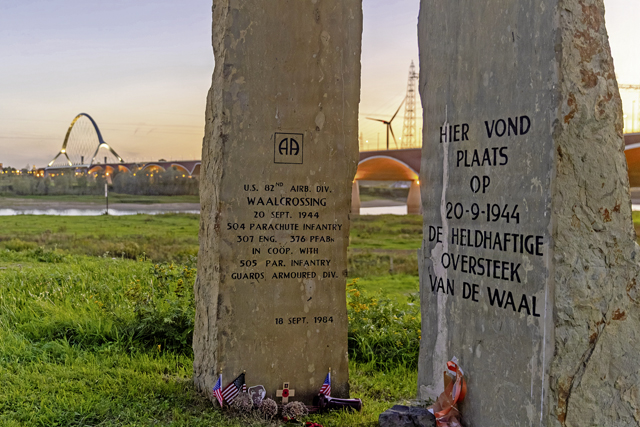
NIJMEGEN, Netherlands — Every evening since October 2014, 48 lights have illuminated Nijmegen’s De Oversteek bridge one by one, marking the lives of the 48 American soldiers killed during the Waal River crossing on Sept. 20, 1944.
As the sun set over Nijmegen on Sept. 20, 2026, Dutch, American, and Allied service members, Dutch veterans, relatives of World War II veterans, and local community members walked together beneath those lights, continuing a tradition that has brought the two nations together for more than a decade.
The march began in October 2014, after the bridge was built with 48 lights to represent the soldiers who died during the crossing.
“Every night at sunset, a veteran walks the Sunset March on this bridge,” said retired Lt. Col. Tim Rowling, Royal Netherlands Air Force. “Each and every night again and again. No matter the weather, there’s always a veteran walking the bridge at sunset.”
For the Dutch community, the march is more than a commemoration of one battle.
“I think that’s such an incredible act that we honor these 48 soldiers every night,” Rowling said. “We honor all our liberators, not only these 48 soldiers, but all our liberators who were able to free the Netherlands in 1944 and 1945.”
For those who continue the tradition, the reason for remembering remains simple.
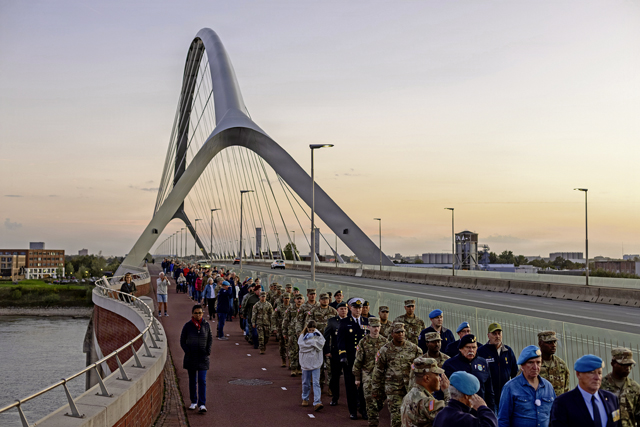
“We are standing here on holy grounds,” said Gos Staps, a retired Dutch military officer. “Those guys gave their lives for us to be able to stand here today.”
“They died for our freedom,” Staps said. “Now we are allowed to do what we want to do, to say what we want to say, and to live life however we want.”
The crossing itself was part of the 82nd Airborne Division’s effort to secure the Nijmegen bridges during Operation Market Garden. American soldiers crossed the Waal under heavy Nazi fire, suffering 48 fatalities during the crossing and the fighting that followed.
More than eight decades later, the Dutch continue to visit the places where American soldiers fought and died.
“Yesterday I made the remembrance jump,” Staps said. “Last weekend I walked 112 kilometers on that very same hill Americans did 82 years prior. We walked around the area of Hell’s Highway as long as possible. We visited every cemetery on those routes. We brought our respective greetings, a candle, and that’s it. Just to remember all those guys who fought for us.”
The annual remembrance of the operation has become part of the relationship between the Netherlands and the United States.
“For a lot of Dutch people, it is important that we continue doing this,” Staps said. “The ones who were there are not able to tell us about what happened in ’44 and ’45. They’re not here to make sure we don’t forget what happened and we don’t forget what those guys did.”
The relationship has continued across generations, with Dutch and American service members standing together at the same places where the two nations first forged their connection during the war.
“They came from America, didn’t know the environment of the Netherlands,” Staps said. “They had no personal reason to fight for us, but they still suited up. They came, they fought and some of them never made it back. It is our duty to forever honor them for what they did.”
As the 48 lights illuminate across the bridge each evening, the march serves as a physical reminder that the relationship created during the liberation of the Netherlands did not end when the war did.
“It is symbolic for all liberators of the Netherlands,” Rowling said.
For the Dutch community, keeping that memory alive is part of carrying the relationship forward.
“If you don’t remember them, and don’t say their names, they will be forgotten,” Staps said.
Eighty-two years after American soldiers crossed the Waal, they did it again. Not under enemy fire, but beneath 48 lights with their Dutch allies by their side, continuing to mark the sacrifices that brought their nations together.


