 Twitter
 Facebook
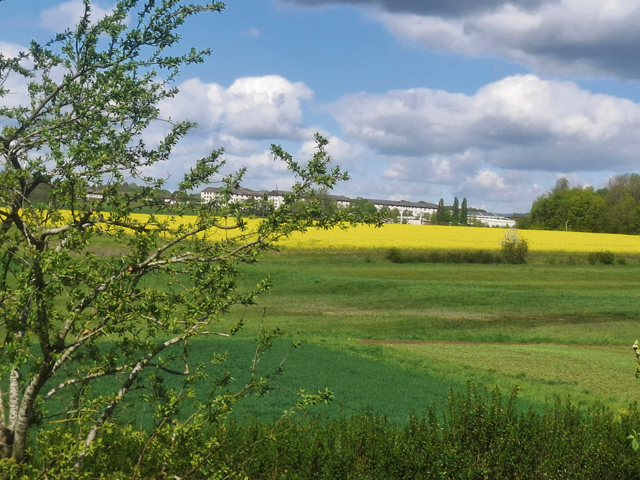
Though the peaceful village of Sembach — complete with its own autobahn exit — is little known to many in the Kaiserslautern Military Community, the U.S. Army post on the hill, commonly called Sembach Kaserne, has played a significant role in the region’s military history.
The village itself has about 1,200 local inhabitants, and about 220 American service members and their dependents have also found a home. Always interested and eager to participate in village events, they add dynamic to a lively community.
An imperial visitor
Sembach was first officially documented in the 13th century and eleven historic buildings are recorded in the village. These include an old schoolhouse, a town hall, two churches, the “Ritterbau,” a sandstone structure along L401, a former post office and a veteran’s monument at the cemetery.
Sembach was part of the French Republic in the early 1800s and it is said that Napoleon himself spent a night at the “Amtshaus” (official house) enroute to Mainz and gave the historic plaza its name “Pariser Hof.” He is also noted for constructing the “Kaiserstrasse” from Paris to Mainz, now known as L401. The “Amtshaus” and the “Zehntenscheune,” (tithe barn), where farmer’s paid dues with the tenth portion of their harvest, had to be torn down and the area in the village center has undergone construction with two new residential buildings.
The village itself is a quiet residential area, where children can play ball on side streets and residents enjoy long walks with furry friends along bright yellow rapeseed fields and blue seas of cornflowers. There are diverse recreational places to experience in the vicinity, such as Donnersberg with the Celtic Village, and its Samhain Festival on Halloween, and Mehlinger Heide.
Military significance
From 1953 to 1995 the community was home to Sembach Air Base, the 86th Fighter Wing and 17th Air Force. Surprisingly, the base was comprised of two sections roughly a mile apart. The one, up on the hill, called “Heuberg” (hay mountain) lies in Donnersberg County and consisted of administrative facilities, a housing area, schools, a chapel and movie theater, a medical center and two clubs. The other section further south housed the runway and support facilities, such as the 601st Civil Engineering Squadron and operational units.
Although the installation is small, it sits inside two different municipal unions (Winnweiler and Enkenbach‑Alsenborn) and even spans two counties. After the war, military planners wanted bases to deter Soviet aggression and to project strength, while local farmers fought to keep their land and repeatedly disrupted surveying. Following protracted negotiations, officials reached a compromise and split the site: the runway was built on the flat terrain in Kaiserslautern County, and the hilltop land, then mostly forest with little agricultural value, in Donnersberg County was used for support facilities. The county and community line (Sembach/Münchweiler) now runs almost directly through the gatehouse at the hilltop entrance.
In 1995 the flightline premises were returned to the German government and have been developed into a 226-hectare large commercial center with quick access to A63. Several companies have settled there, including a waste disposal enterprise, a glass recycling firm, energy and IT-related firms and a large shipping and distribution company. A water tower close to the control tower paints a lovely red skyline during summer sunsets.
Army taking over
Many of the organizations on the upper section of the base were relocated to Ramstein Air Base after 1995 and eventually the premises were closed in 2010 to be transferred to the U.S. Army.
Since then, a number of Army organizations have moved to the installation including 68th Theater Medical Command, Medical Readiness Command, Europe, Defense Health Network Europe, 10th Army Air and Missile Defense Command, DOWEA – Europe Elementary School, 52d Air Defense Artillery (10th AAMDC), 30th Medical Brigade, 519th Hospital Center (30th MB), U.S. Army NATO Brigade, 409th Contracting Support Brigade, 598th Transportation Brigade, Exchange (AAFES) – Europe, TRICARE Eurasia & Africa, Medical Support Unit – Europe, 779th Medical Wing, 33rd Army (USAREUR) Band, Defense Health Agency, American Forces Network – Europe, Correctional Activity – Europe, Service Credit Union Europe HQ, US Navy Warrior Transition Program (WTP), USAREUR-AF Vehicle Registration, U.S. Army Aeronautical Services Detachment, U.S. Army Corps of Engineers, Central Europe, Defense Logistics Agency – Energy, Defense Manpower Data Center, Support Center – Europe, WIC Overseas, Army Recreation Machine Program, Region Library Services, Musical Instrument Repair – Europe/Pacific, and Network Enterprise Center Ops Cell, 102d SIG Bn.
Country life
Sembach offers year‑round activities, from the August Kerwe and parade to the summer Bulldog Rennen tractor races, St. Martin’s parade with its bonfire, and the November boundary walk. The Musikverein presents regular concerts, December features a living Advent calendar, and three local restaurants provide welcoming spots to meet residents.
The newly formed Landfrauenverein brightens the village with seasonal flower plantings and decorations, organizes family events and flea markets, runs a small library, and invites new members. A book‑exchange booth is also available at the central bus stop.
Community Engagement
Military members and their families actively supported events all season. 30 MED soldiers helped set up and break down the annual town festival, while DES provided a firetruck to fill water tanks. The American community ran a food and drink stand at Christmas events, and a German‑American Stammtisch — plus a Facebook group — led to a German‑bowling night. A language and culture class began in February, a town hall for the American population was held in March, and service members attended the Night of the Oscars; more highlights are planned. Several U.S. and NATO children now attend the local kindergarten and are experiencing German culture from an early age.
Storks love Sembach!
The former runway area has been renatured and is home to large flocks of storks every year as well as scores of smaller bush dwellers and rodents. A large solar park is located at the eastern end of the former runway. A bold old oak tree, once hit by lightning, at the corner of the access road coming up “Snake Hill” speaks of the times when service members were welcomed home with yellow ribbons in the 1970’s.
Quaint — “klein, aber fein,” as Germans say — Sembach may be small, but it has played an outsized role in history and remains a charming community today.

Welcome to Sembach!
I am deeply encouraged by the strength of our German‑American partnership. In nearly two years as Mayor of Sembach, we have achieved much, and it is truly inspiring to see our communities steadily unite. I hope we continue building on this momentum together. Sembach is proud to have you with us always.
Personally, alongside my mayoral duties I also proudly serve with the U.S. Forces. As I mark my 20‑year anniversary this year, watching our communities grow closer fills me with great pride and gratitude.
Mayor Peter Beutler


