 Twitter
 Facebook

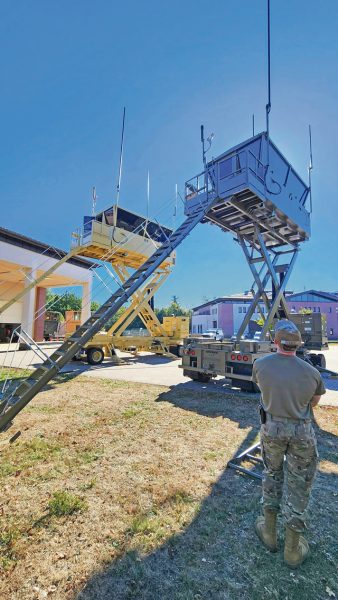
Airmen from the 1st Combat Communications Squadron received the last of three next-generation MSN-14 Mobile Air Traffic Control Towers this week at Ramstein Air Base.
The arrival marks a major milestone for the 435th Air Ground Operations Wing as it fields advanced combat airfield operations systems across U.S. Air Forces in Europe and Air Forces Africa.
The new towers are part of an $83 million modernization initiative designed to transform tactical air traffic management across the European and African theaters.
“It is exciting to field a new capability that not only replaces an aging system but brings forward a tactical solution to our combatant commanders that is capable of sustained operations in any conditions,” said U.S. Air Force Senior Master Sgt. Alex Riley, 1 CBCS Airfield Operations flight chief.
The MSN-14 replaces the MSN-7, which has remained in continuous service for more than 30 years. The upgrade delivers modernized communications, elevated visibility, and expeditionary air traffic control to dynamic operational environments.
Modern capabilities, tactical mobility
Mounted on a heavy-duty, scissor-lift trailer, the MSN-14 raises air traffic controllers to an eye-level vantage point of nearly 20 feet above the flightline. This expanded elevation gives controllers an unobstructed 360-degree view of runways, taxiways, and terminal airspace that is essential for managing complex flight patterns during contingency operations, exercises, or humanitarian relief missions.
Unlike legacy expeditionary shelters that required trade-offs between mobility and functionality, the MSN-14 replicates the robust equipment and operational capabilities found in permanent, fixed-base ATC towers. Inside the climate-controlled cab, controllers have access to state-of-the-art secure radios, tactical meteorological instrumentation, airfield lighting controls, and full multi-channel audio recording capabilities required for flight safety and regulatory compliance.
Built for Agile Combat Employment
The MSN-14 was built in response to the operational demands of Agile Combat Employment, which prioritizes proactive, reactive, and agile dispersal of combat assets across austere or contested operating locations throughout the USAFE-AFAFRICA area of responsibility.
Engineered for rapid worldwide mobility, the complete system can be hitched and towed over un-improved roads or loaded directly into tactical and strategic airlift platforms. Once transported to an austere airstrip or forward operating site, the system can be quickly offloaded, leveled, raised, and operational within hours, establishing instant command and control in locations where fixed infrastructure is degraded or nonexistent.
A lasting legacy replaced
For decades, the MSN-7 served as the Air Force’s primary mobile ATC platform, deploying across global theaters from desert deployments to disaster relief taskings. However, maintenance challenges, obsolete parts, and outdated communication architectures prompted the requirement for a modern, reliable replacement capable of meeting the tempo of today’s operational landscape.
“With the fielding of the MSN-14, 1st CBCS controllers possess a durable, highly adaptable asset that ensures safe and efficient air operations anytime, anywhere,” said U.S. Air Force Master Sgt. Thomas Lenga, 1 CBCS Tactical Airfield Operations flight chief. “Whether supporting NATO joint exercises, crisis-response taskings, or forward-deployed ACE maneuvers across Europe and Africa, the new tower ensures tactical com-mand and control of the skies remains firmly in the ca–pa-ble hands of the Air–men on the ground.”


