 Twitter
 Facebook
Let’s hit the beach!
Living in southwest Germany amid the Palatinate Forest, vineyards, castles, and sparkling rivers, you might not immediately picture sandy beaches and a maritime vibe. Spain, Italy and Greece may first come to your mind when planning a beach vacation. Yet believe it or not, Germany boasts more than 2,000 kilometers of coastline, including 76 inhabited islands, and cities that offer nostalgic Hanseatic charm.
Getting there may require an extended weekend trip and somewhat travel, but there is much to experience along the North and Baltic Seas. The nearest point on the North Sea coast from Kaiserslautern is about 669 km and takes roughly six hours.
There is a chain of islands along the German bight along the northwest coast called Borkum, Norderney, Juist, Langeoog, Spiekeroog and Wangerooge. Helgoland is a rocky island in the middle of the North Sea, mainly a strategic naval port and a duty-free zone. Further north lie Föhr, Amrum and Sylt islands.
The Wadden Sea is a vast intertidal zone of mudflats, sandbanks, salt marshes and barrier islands along the southeastern North Sea, stretching across the Netherlands, Germany and Denmark. It is a UNESCO World Heritage site and one of the world’s largest unbroken tidal flat systems stretching for about 500 kilometers in length. It features sandy beaches, abundant seafood and a charming maritime atmosphere; but at low tide the sea recedes by up to three meters, exposing crabs and other marine life. Walking across the Watt is a popular activity, but it should always be done with a guide—many visitors have been swept out to sea or stranded on sandbanks when the tide returned unexpectedly. For further details, also see the Lifestyle article in the July 3 edition of the KA.
Moin!
As we head toward the North Sea, two worthwhile stops await. First Papenburg, an enchanting small town on the Ems whose medieval center, crisscrossed by canals and lined with fishing boats, offers an unexpected maritime charm.
Renowned for its shipping industry, it is home to one of the world’s largest shipyards, specializing in massive cruise liners. Meyer Werft has built vessels such as the “Disney Wish” and hundreds of spectators gather to watch 16‑deck ships being towed backwards down the shallow, narrow Ems River on their way to the open sea. Don’t miss an exciting tour of the shipyard https://www.meyerwerft.de/en/visitors
A further charming stop known as the “Tor zu Ostfriesland” (Gateway to East Frisia), Leer is a riverside town of roughly 35,000 residents. It sits on the Leda, which joins the Ems River nearby. That riverside curve remains the heart of town today, featuring a panoramic riverwalk with a small marina, a lively pedestrian zone, and a historic Hanseatic quarter. Scenes of the town are also featured in a popular German crime-comedy series called “Friesland.”
Germans often joke that East Frisians have a distinct character and even their own regional tongue. Plattdeutsch is largely unintelligible to speakers of standard German—its vocabulary and sounds show influences from English, Dutch and older dialects, and include local terms like Fehn for a peat fen and Siel for a small water inlet that don’t exist in standard German. East Frisians are also stereotyped as being very friendly, but don’t speak much. Instead of saying “Guten Morgen,” “Guten Tag” or “Guten Abend,” people there commonly greet one another with ‘’moin,’’ a word that literally means morning but is used at any time of day.
Besides its beaches, Emden at the mouth of the Ems and Hanseatic Wilhelmshaven, with its beach promenade and maritime museum, are well worth a visit. The picturesque fishing village Greetsiel offers quaint shops selling maritime fashion and souvenirs, sample a Krabbenbrötchen (fresh shrimp sandwich) straight from the fishermen and enjoy a cup of Ostfriesentee, the region’s signature tea.
Hanseatic flair
Two further places somewhat further north lie along the Weser River. The “Freie Hansestadt Bremen” (Free Hanseatic City of Bremen) is Germany’s smallest state, completely embedded in the State of Niedersachsen, and is merely comprised of Bremen and Bremerhaven.
Its special Hanseatic status is based on the Hanseatic League, a commercial and defensive confederation of merchant guilds and market towns developed in the 12th century. Port cities awarded a Hanseatic status held special market rights and brought wealth, prosperity and prestige.
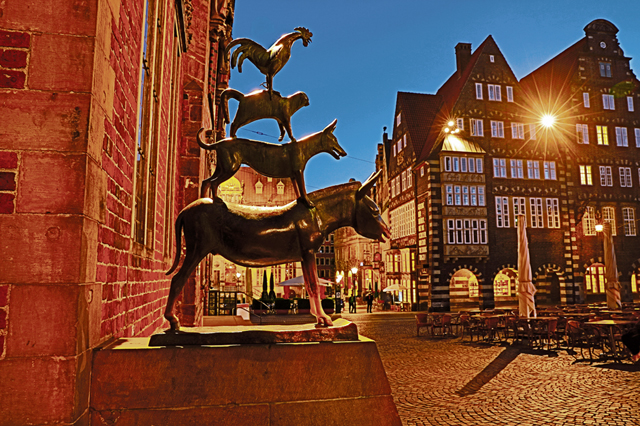
Bremen is well known for the story of its musicians, based on the fairytale by the Brothers Grimm published in 1819, where an old donkey, a dog, a cat and a rooster team up and defeat evil. Meanwhile the animals have become iconic and pedestrian lights in the city depict the four figures.
The Altstadt in Bremen, with its medieval guild houses and a statue of the four, is definitely a point of interest. Legend has it, if you touch the leg of the donkey, you get a wish. The Schnoorviertel is the oldest city section with cobble stone alleys and unique shops. The Schlachte in the heart of the city is located directly along the Weser River. The former port now houses restaurants, bars and pubs as well as beer gardens. For more inspiration visit: https://www.bremen.de/tourismus
Travels to the New World
Bremerhaven, founded in 1827, is famous for a completely different reason. With waves of emigrants heading to the New World, the passenger port in Bremen became too small to handle the masses. A new port was built in 1854 and eventually developed into the largest emigrant port in Europe, known as Columbus Kai.
Today the joint port, both in Bremen and Bremerhaven, is the second largest in Germany after Hamburg. It has eight individual terminals, including a cargo port, a cruise ship terminal, a fishing terminal and the automobile terminal with a gigantic parking lot, where 95,000 cars can be parked for further handling. Bremerhaven may also ring a bell as most vehicles and household goods shipped from the United States reach their destination there.
Bremerhaven may not be the most picturesque city, but it holds a treasure chest full of cultural heritage, history and climate in its “Hafenwelten.” The old harbor is full of historic ships, the “Schifffahrtmuseum” has vessels, such as the “Bremer Kogge“ built in 1380. The “Zoo am Meer” features sea animals and you can stroll along the dike with impressive cranes, cargo and cruise ships in the distance and a view of the enchanting Pingel lighthouse.
The “Deutsches Auswandererhaus” (German Emigration Center) has historical records and ship manifests for over a century of emigration. Over 7.2 million people boarded ships to seek their fortunes in the New World. There you can embark on a journey through time and experience an astonishing interactive museum or trace your roots in the genealogy section. https://www.dah-bremerhaven.de/en/experience
The Klimahaus offers a different kind of voyage. Under the motto “nine places, five continents, one planet” it guides visitors along the eighth longitude through varied climate zones, part science center, part theme‑park, so you can experience a world tour in a single afternoon. https://www.klimahaus-bremerhaven.de/en.
To round off our North Sea tour, we can head a little farther north to Cuxhaven or Büsum to catch a ferry to Helgoland, or drive to Niebüll and take the car‑shuttle train across the 11‑kilometer Hindenburgdamm to Sylt, Germany’s most popular and often priciest island. From there, just short of the Danish border, it’s only about 39 kilometers east to Flensburg on the Baltic coast. For more inspiration visit: https://nordseey.de/en/north-sea-beaches
Stay tuned for more adventures along the sea in next week’s edition!


