 Twitter
 Facebook
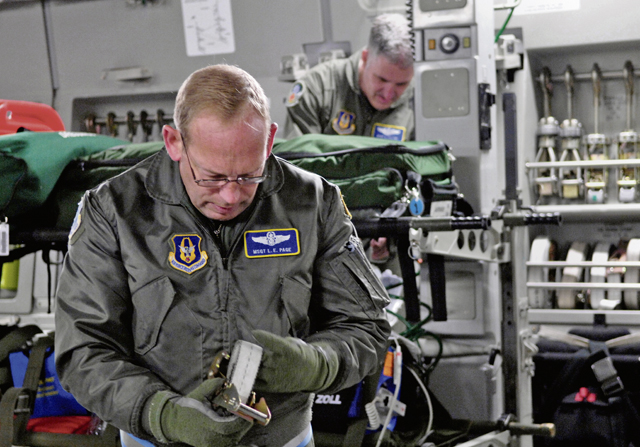
This year the summer hasn’t been as hot as meteorologists had expected, but if you’re in for a real deep freeze, at -70° C (-94° F), join us on an exciting trip to the seventh continent!
This week we will take you on a blood chilling journey with a historic landing on Ross Island, Antarctica, about 16,700 kilometers (10,400 miles) away from the Kaiserslautern American Community. The author of this article met Master Sergeant (R) Lawrence Page on a recent trip to Antarctica. Page is familiar with the Kaiserslautern Military Community, loves Nanstein Castle in Landstuhl and was eager to share his story about an extraordinary mission during his military career.
Since 1956 the United States has carried out supply missions to Antarctica under the code name “Operation Deep Freeze.” The missions have ensured a continuous U.S. presence in Antarctica and safeguarded supplying researchers with equipment and needed resources, mainly at McMurdo station.
McMurdo Station is a coastal station at the southern tip of Ross Island, about 3,864 km (2,415 miles) south of Christchurch, New Zealand, and 1,360 km (850 miles) north of the South Pole. It is the largest scientific research station and up to 1,200 scientists are on site in the summer months. During the harsh winter when temperatures go down to -62° Celsius (-81° Fahrenheit) accompanied by fierce winds, the population goes down to about 200 people. And, this is where our icy story sets in late August 2007.
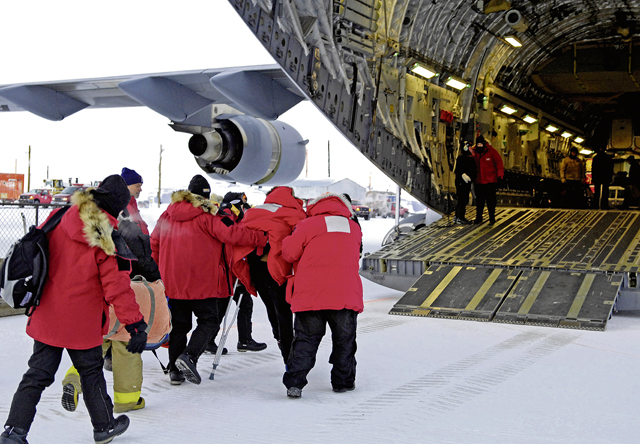
The 446th Aeromedical Evacuation Squadron from McChord Air Force Base, Washington, had just completed its routine winter fly-in missions and was preparing to depart Christchurch to Washington when the crew was requested to stay for an additional 24 hours for an unplanned special mission. An urgent aeromedical evacuation of a patient in critical condition in the deepest of winter.
As with all missions, first requirements had to be met, paperwork coordinated, emails needed to be sent, and weather conditions had to be evaluated before the mission could be launched. Meanwhile the Pegasus White Ice Runway had been partially disassembled and needed to be put back in place, while air traffic controllers and forecasters also had to be on stand-by and prepared for a quick turnaround under unfavorable circumstances.
The pilots and flight crew were soon ready to head out on a bold venture together with two critical care nurses and three medical technicians, all trained to provide basic care all the way up to advanced life support care. According to record, the patient was in very critical, although not in life-threatening situation, but urgently needed surgery within 48 hours.
The C-17 Globemaster III quickly transformed into a mixed cargo and patient transport aircraft, while the medical team prepared and checked their equipment for the patient pickup in icy terrain. Two snow caterpillars that couldn’t be delivered on the last regular flight were loaded for practical reasons and as an example of multi-purpose mission planning.
MSgt. Lawrence Page, one of the three medical technicians on board, recalls that after a six-hour flight from Christchurch, the aircraft attempted to land under blizzard-like conditions. The weather forecasted that the aircraft would be unable to touch ground at nearly zero-visibility, and the whole team on board knew that it was in for a chilly challenge.
On the second approach the clouds lifted and the blowing snow stopped allowing the Globemaster to safely land on the icy runway. While on the ground engines one and four were left on high idle and engines two and three at normal idle to avoid freezing and preventing the aircraft from being stranded.
Then, immediately it was all hands on deck and the complete team, flight crew, ground support and medics, sprang into action with the precision of a Swiss watch. The snow cats were unloaded, the medics met and comforted the patient, carefully boarded him and pre-flight checks were carried out — with almost everything happening simultaneously. Just short of 25 minutes later the aircraft was back in the air while the clouds returned, and the whipping wind picked up again.
Page recalls that the patient was in surgery in Christchurch before the flight and medical crew finished their debriefing and were back to their billets. It was a good outcome for the patient and led to his full recovery thanks to the dedicated and exemplary team spirit.
Aeromedical evacuation has global reach regardless of location, and medical needs can be met as fast as the aircraft can get there. We’ll never know if one of us will need unexpected medical support one day, even if it is at the end of the world. The 18th anniversary of this mission Aug. 28, 2025, is literally only the “tip of the iceberg” considering the thousands of aeromedical evacuation missions having taken place since then and will continue in the future.


