 Twitter
 Facebook
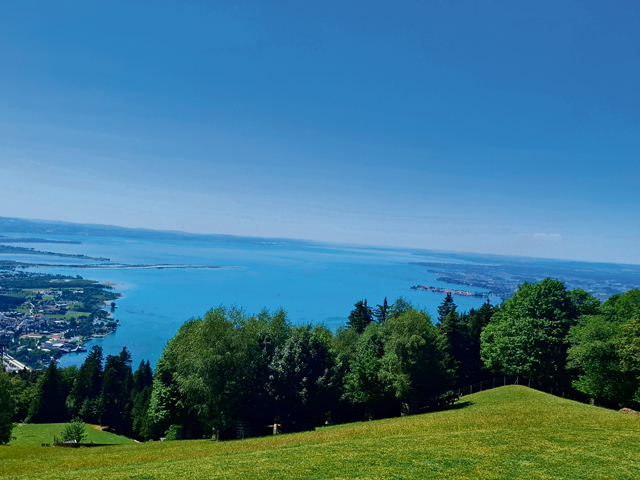
lake, and Germany to the right.
Story & photos by Gina Hutchins-Inman, 86th Airlift Wing Public Affairs
Today’s trip will lead us to Lake Constance, known locally as the Bodensee, a vast freshwater basin at the foot of the Alps that stitches together Germany, Austria, and Switzerland. As Germany’s largest lake, it is 63 kilometers long and 14 kilometers at its widest point.
Its shoreline is dotted with medieval towns, islands, museums, and cycling routes that invite slow travel and discovery. Lake Constance is a luminous borderland where Alpine silhouettes meet gentle promenades. Towns and cities such as Meersburg, Friedrichshafen, Unteruhldingen, Lindau, Bregenz, and the Pfänderbahn invite visitors to relax and enjoy with an almost Mediterranean ambiance.
Meersburg and Unteruhldingen
Meersburg sits like a storybook on the lake’s western shore. Narrow lanes, a hilltop castle, and vineyards that slope down to the water. Meersburg’s medieval castle and lakeside promenade make it one of the region’s most photographed towns. There is even a Medieval style hotel on the main road with knights in shining armor standing along a torch lit staircase. Stroll the lakeside promenade, enjoy a coffee or an ice cream at the waterfront. Hop on a boat to admire the town from water, then turn your gaze south to the Swiss Alps, where snow-tipped peaks glitter in the sun across the shimmering lake. The Bodensee Weinfest takes place from Sep. 11 – 13 this year. https://www.meersburg.de/en/Tourism
Nearby Unteruhldingen preserves an altogether older human story at its Pile Dwelling Museum, where reconstructions of prehistoric stilt houses recall life on the lake millennia ago. The outdoor museum is an evocative counterpoint to Meersburg’s medieval charm and a UNESCO World Heritage Site. https://www.pfahlbauten.de/en/
Friedrichshafen and the Zeppelin legacy
At about the middle of the northern shore, Friedrichshafen celebrates the age of lighter‑than‑air flight. The Zeppelin Museum traces the technological and cultural history of airships and anchors the town’s identity. Visitors can explore exhibits that connect local industry to global aviation history, the Dornier Museum displays replicas of vintage aircraft where visitors can climb aboard.
The city also has a long promenade along the lake with an outdoor concert stage, beach bars and beer gardens, and holds numerous events throughout the season. Restaurants and cafés invite visitors to sit by the sea and enjoy fresh fish, a pedestrian zone offers unique small shops and eateries. The nearby airport offers blimp rides over the lake, a bit pricey but worth the amazing view. https://www.friedrichshafen.de/
Friedrichshafen’s harbor is a busy hub with multiple ferry routes: a two‑hour sailing to Bregenz, a direct ferry to Romanshorn in Switzerland, and a fast catamaran that reaches Konstanz in under an hour. From the water, sailboats, stand‑up paddlers, and anglers criss cross the route, adding to a lively, ever‑changing lakeside scene.
Lindau and island life
Lindau, an hour’s boat ride east, crowns a small island with a compact medieval core. Its harbor entrance is famously flanked by a Bavarian lion and a lighthouse that together form one of the lake’s most photographed vistas. Narrow, cobbled streets climb past the Mangturm and the ornate Neues Rathaus, while cafés, galleries, and boutique shops spill onto sunny squares.
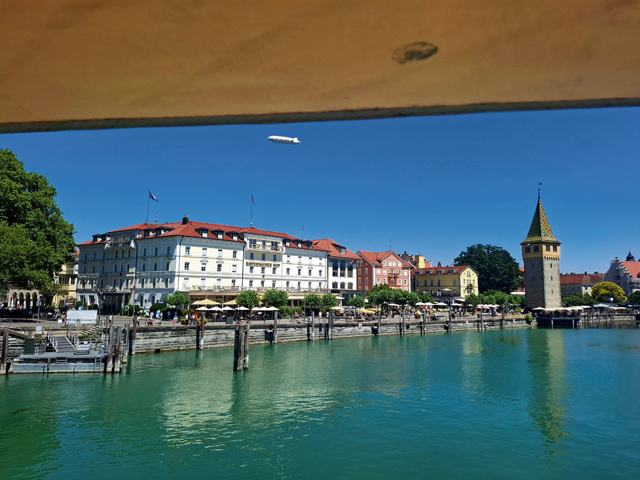
The island is linked to the mainland by a short causeway, yet retains an intimate, almost Mediterranean atmosphere against an Alpine backdrop. Regular boat services make Lindau a lively hub for lake crossings, and its lakeside promenades, marina, and seasonal markets invite slow strolls and easy access to nearby towns and islands. https://www.lindau.de/en/
Bregenz and the Pfänderbahn
East of Lindau and across the border in Austria, Bregenz combines cultural ambition with mountain access. The Pfänderbahn cable car lifts visitors from the lakeside town to panoramic viewpoints in six minutes. From the summit one can see the lake framed by hundreds of Alpine peaks, standing in Austria you can see Switzerland on the south coast and Germany to the right. The Pfänderbahn is a short, scenic ascent that opens hiking trails, a wildlife park, and sweeping vistas over the border triangle. www.bregenz.at
Konstanz
The bird’s eye distance between Bregenz and Konstanz, located in the southwest, is 46 kilometers. The city blends a compact medieval old town with modern amenities: university life, museums, and a busy harbor. The city’s harbor is a starting point for scheduled roundtrips and liner services that visit Meersburg, Überlingen, and the island of Mainau, making Konstanz an ideal base for day trips on the lake.
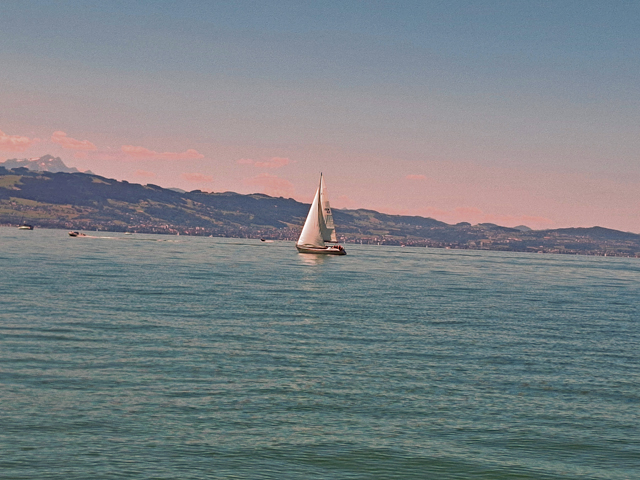
peaks of the Swiss Alps as a backdrop.
Stroll the old town in the morning, take a short boat or ferry ride in the afternoon, or head back to Meersburg with a stop along the Blumeninsel Mainau (Flower Island). Mainau is best known for its extensive, year‑round gardens, arboretum, and themed floral displays. The island is a horticultural showcase that draws families, gardeners, and photographers. www.konstanz.de, https://www.mainau.de/de
Romanshorn
Surprisingly, the border to Switzerland is just behind the city limits of Konstanz and Romanshorn can easily be reached by car, bus or by boat.
The town feels genuine Swiss, with oversized cowbells, fluttering flags, and dark wooden houses that give its streets a timeless charm. Its harbor is the focal point, which offers a landscaped promenade lined with cafés and restaurants, a busy marina, and an active ferry terminal that keeps the waterfront lively. If you plan to cross the border into Switzerland, carry your passport and check entry requirements for U.S. travelers in advance; there are immigration and customs checks both on land and at sea. https://www.romanshorn.ch/
Rhine Falls
The Rhine Falls, near Schaffhausen and Neuhausen in northern Switzerland, span roughly 150 meters across and plunge about 23 meters, creating a thunderous spectacle that can be enjoyed year‑round. Here the Rhine, fed by meltwater from the Gotthard region of the Alps, gathers strength before embarking on its roughly 1,250‑kilometer journey northwest to the North Sea at Rotterdam in the Netherlands.
Überlingen
The last stop on our journey around the lake is in Überlingen, which sits on the Überlinger See, a side arm of Lake Constance. It is prized for one of the lake’s longest promenades, lively harbor activity, and its role as a departure point for scenic boat excursions. The town’s landing stage is a convenient gateway for roundtrips and direct services to Mainau and Konstanz. www.ueberlingen.de
Beaches
Beach lovers won’t be disappointed: the Bodensee offers numerous sandy and grassy spots for swimming and sunbathing, from Strandbad West, Ost, and Nußdorf in Überlingen to Strandbad Hörnle, Litzelstetten, and Dingelsdorf near Konstanz, plus pleasant public shores at Meersburg and Friedrichshafen and many smaller coves scattered along the shore. Facilities vary by location, some strandbäder provide cafés, changing rooms, and diving platforms, while others are more basic, so check amenities in advance. Not all beaches have lifeguards, and many lakefront entries are pebbly, so bring bathing shoes for comfort and safety. https://www.weg.de/inspiration/straende/bodensee
A region for movement and reflection
The lake invites both leisurely, reflective days along its promenades and lively exploration by boat, bike, or on foot. The Bodensee is a layered landscape: prehistoric pile dwellings, medieval ramparts, industrial museums, and sweeping alpine panoramas. Each town offers a different window into the lake’s long story and something to delight every kind of traveler!


