 Twitter
 Facebook
Did you know that musicians from the Westpfalz region, especially from Mackenbach, Weilerbach and Kusel, have played a decisive role even on distant American stages?
In the 19th century, employment in the region was scarce and there were only limited opportunities for the fine musicians known in the region. Up to 2,500 instrumentalists set out per year and joined military orchestras, court ensembles or played in coffee houses. Some joined circuses to announce spectacular highlights with well-known drum rolls or fanfares and to entertain spectators between acts.
Others opted to venture throughout Europe to countries such as France, Spain, Italy and as far away as Türkiye or Palestine. Anna Wunderlich was one of the few female musicians, who met her husband from Kusel during a tour to Cyprus. Their son Fritz became a renowned tenor and the music venue Fritz-Wunderlich-Halle in Kusel was named after him.
Even more adventurous musicians set sail to the New World to seek their fortunes and founded their own orchestras in the United States. Ensembles such as the “Mackenbacher Wandermusikanten” were rather popular in states in the eastern part of the country.
Some of the wandering musicians chose to return to their hometowns after roaming the world for a few years, while others decided to stay and even became famous throughout America.
Heinrich Jacob from Mackenbach was one of these musicians who emigrated to New York. While playing in a club with his band one evening, he managed to convince a young waiter to join them. This was none other than Frank Sinatra in his first public performance, who later became a member of his band. Heinrich was rather successful under his artist name “Bill Henry” and his band called “Headliners.” The Musikantenmuseum boasts Sinatra’s original trombone in its selection of artefacts.
Another famous wandering musician from Miesenbach was Karl Schirra, who played in ensembles in Boston, Brooklyn and Philadelphia after World War I, mainly as a circus musician. It is noted that some of the musicians actually became wealthy during the course of time and numerous prestigious houses in Mackenbach are reminiscent of the wandering musicians and their contributions, marked with plaques.
One of the two musical museums in the Westpfalz is located in Mackenbach, where up to two-thirds of the inhabitants lived on “musical money.” It is dedicated to a career field that shaped the prosperity of the whole Westpfalz region. It has a wide display of photos and unusual instruments as well as its showpiece, a large model of Circus Busch from Berlin which is acknowledged in the Guiness Book of World Records. https://www.musikantenmuseum.de/
The event Musikantenlandtag 2025 is taking place in Mackenbach Aug. 23 from 3 – 7.30 p.m. The day includes a sneak peek at the museum for children, a magic show with magician Tonga for the whole family, an official opening by County Commissioner Ralf Leβmeister and musical entertainment with Musikverein Mackenbach and Reichenbach-Steegen. Regional specialties and drinks will also be provided.
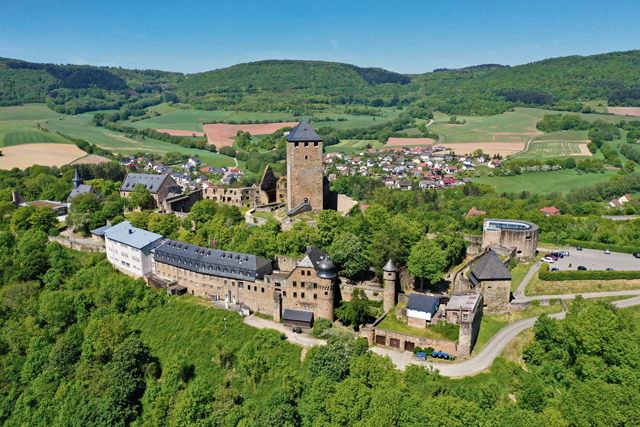
The second is the Musikantenland-Museum at Castle Lichtenberg in Thallichtenberg near Kusel. It lets the infamous musicians come back to life with large displays of realistic scenes and depicts their daily lives. In addition to hearing original music composed by these masters of the trade via headphone, the world’s largest tuba is on display. https://burglichtenberg.pfaelzerbergland.de
Maybe one of your ancestors belonged to this special lineage of musical talent and you’ve inherited it as a singer, instrumentalist or just have an ear for great music. Next time you hear a drum roll, remember the adventurous musicians from the region.


