 Twitter
 Facebook
As Mexico, the United States and Canada look forward to hosting the Soccer World Cup 2026 in just a few days, Kaiserslautern is already a step ahead. Or twenty years to be more precise!
A short, but notable and decidedly sporty chapter in the city’s story, especially for soccer fans, came in 2006 when Kaiserslautern, the smallest of the 12 German host cities, turned into a colorful festival from June to July.
One of a dozen
Kaiserslautern was selected not only for the storied success of 1. Fussballclub Kaiserslautern’s (1 FCK) four‑time German champions in 1951, 1953, 1991, and 1998, but also as the birthplace of beloved players Fritz and Ottmar Walter.
The city’s strong regional infrastructure, its proximity to Ramstein Air Base, able to accommodate U.S. players and receive distinguished guests such as the King and Queen of Spain, and an already sizable stadium all helped persuade FIFA to give the relatively small city a prominent role in the tournament.
In addition, the short distance from the train station to both the stadium and city center made it easy for fans to stroll down Schneiderstrasse’s “Fanmeile” and visit the pedestrian area’s pubs and restaurants. Furthermore, a large group of dedicated American 1. FCK fans served as the little tongue on the scale for FIFA’s decision.
Although a few alterations needed to be made prior to the games, for example, Autobahn A6 was widened to three lanes, construction and beautification projects were carried out throughout the city. Betzenberg stadium was enlarged to meet FIFA standards and renamed “Fritz-Walter-Stadion” in his honor, the city was ready for the world to come!
The whole world as guest in Kaiserslautern
Fans and players from around the world began flocking in on June 11, ahead of the opening match the next day, while shuttles from Ramstein Air Base were launched to prevent traffic chaos and sustain a month of thrilling games and warm hospitality.
Enthusiasts from Australia, Brazil, Italy, Japan, Paraguay, Saudi Arabia, Spain, Trinidad and Tobago, and the United States found their way to Kaiserslautern, while many of them had never heard of the city before and had to consult maps to even find it!
The entire city became one big fiesta under perfect weather, with daily parades showcasing drum groups, cheerful dance ensembles, and traditional music—Kaiserslautern felt like the whole world was at its feet.
Hundreds of Australians and New Zealanders arrived in camper vans, often parked in no‑parking zones while authorities turned a blind eye, and neighbors greeted them with brötchen and coffee each morning—hospitality at its finest. The mates from Down Under also tended to be rather thirsty and for a short time, all beer in the city was sold out, so that new kegs had to be quickly organized from breweries throughout the region.
Trinidad and Tobago brought a splash of color, parading through the streets in exotic, dragonfly‑like costumes, while inflatable kangaroos seemed to outnumber those in Australia. Fans from around the globe waved bright flags and celebrated peacefully and the city also experienced Carnival in Brazil in the middle of summer.
At times the city hosted more visitors than its 100,000 residents, with Saudi sheikhs arriving by helicopter, and the USA scoring a sweeping 1:1 tie against Italy on June 17, the team that later won the World Cup in the finals in Berlin.
That day the stadium in Kaiserslautern also held a moment of silence for Fritz Walter who had passed away on June 17, 2002. Germany’s third‑place finish rounded off the championship, which afterward earned the nickname Deutsches Sommermärchen (Germany’s summer fairytale).
Fritz and his legacy
It is unfortunate that local hero Fritz Walter didn’t live to experience Kaiserslautern as the venue of the 2006 Soccer World Cup.
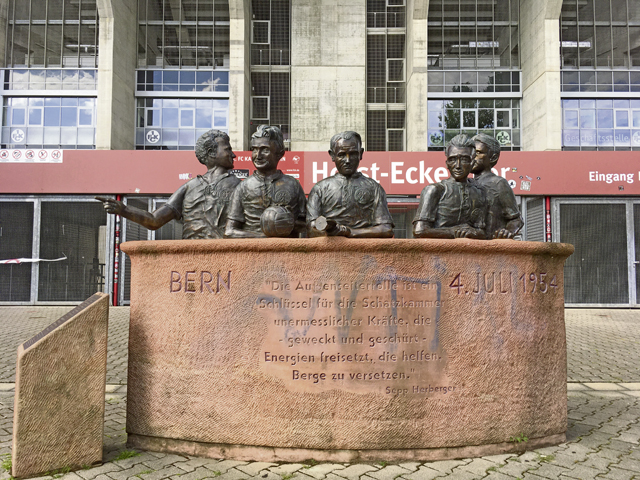
Fritz Walter and his brother Ottmar were born and raised in Kaiserslautern. They came to fame as prominent German soccer players in the 1950’s. Together with Horst Eckel of Vogelbach, they starred in the Soccer World Cup in 1954 when Germany won the championship. They not only brought fame to themselves, but shaped following generations of dedicated and passionate soccer fans in Kaiserslautern and the region, sometimes referred to as the “red devils” based on their red team color.
Not known by many, Fritz was drafted into the German Wehrmacht at Daenner Kaserne in 1940, stationed at various bases around Europe and eventually served in the 2nd Company Fortress Battalion 902, responsible for Sardinia and Corsica. During his time in service, he had a very adventurous time as soccer player and played in various formations as “guest player” with the 1. Fussball Club Kaiserslautern.
In 1945 he was taken as a prisoner of war, encamped in Romania, and according to his autobiography, a severe case of malaria and an impromptu soccer game with two camp guards, saved him from being deported to Siberia.
Miracle of Bern
Upon his return, he played on various teams in southwest Germany, then with the 1. FCK and was appointed as team captain of the German national team. The high point of his career came with Germany’s 1954 World Cup triumph in Switzerland, the “Miracle of Bern,” when they scored the winning goal against Hungary six minutes from time. A bronze soccer ball at the Kaiserbrunnen by Mainzer Tor in Kaiserslautern bears his hand-signed signature.
There is an American 1 FCK fan club with about 10,000 followers on Facebook:
https://www.facebook.com/
people/American-1FC-Kaiserslautern-Fan-Club/100069043911631/
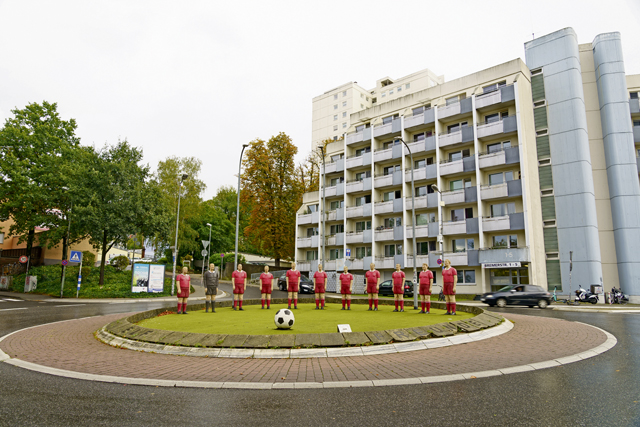
His team is still referred to as the “Walter Elf” and the formation “Elf Freunde” (eleven friends) was erected with statues of him and his teammates in a traffic circle leading to the stadium, close to the train station in Kaiserslautern. A signpost at Schillerplatz depicts directional signs of all nations that participated in Kaiserslautern in 2006.
Trusting that the 2026 championship across the seas delivers the same peaceful, sportsmanlike vibe as Fritz demonstrated during his time, warmest wishes to all teams and players. Now, let the games begin!
Keep an eye out for the next Time Travel in Kaiserslautern feature — one more significant era is on its way.


