 Twitter
 Facebook

The Department of War is the single largest user of facility utilities in the Federal Government. In FY25 (FY26 data had not been released at the time of publishing this article), the Air Force contributed the following (data includes Space Force and Air National Guard) in installation energy/water consumption and cost:
Total Energy Cost ($): 1,105,977,475.13
Total Energy (MMBTU): 58,402,110.94
Total Water Cost ($): 104,496,320.00
Total Water (kGal): 23,439,007.15
Energy management has become increasingly important to minimize energy costs required to operate installations. Savings in energy costs reduce the financial burden on the installation’s funding, allowing limited resources to be redirected towards mission readiness and infrastructure modernization. Dramatic fluctuations in energy cost significantly impact already constrained operating budgets, creating a stronger incentive to conserve and explore methods to reduce energy consumption.
A strong commitment from US civilian, active-duty personnel, and local nationals, is essential for effective energy management. Successful energy conservation can only be achieved with the support and cooperation of each facility user. It is the responsibility of all personnel to promote conservation and efficient use of energy and water.
In the last few fiscal years, Ramstein AB has consistently ranked in the top five when compared to other Air Force installations and their respective energy costs alone. Above graph shows historical data for Ramstein AB’s utility costs throughout the years. This data reflects the significant energy consumption and cost at Ramstein AB, highlighting the importance of continued energy management efforts to optimize resource usage and reduce overall expenses.
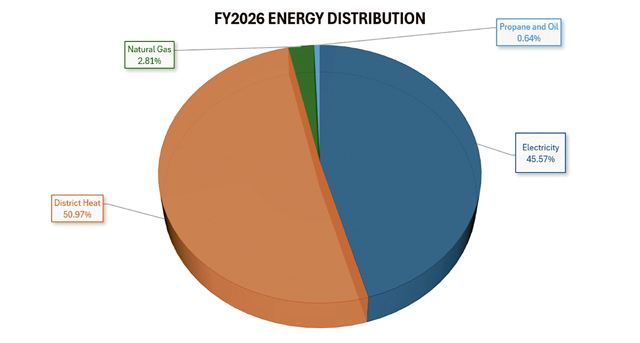
In FY 2026 (estimated), district heat (50.97%) and electricity (45.57%) were the greatest contributors to Ramstein AB’s total energy consumption. Given this, we are encouraging all members of our community to focus on existing systems and practices that will have the greatest conservation impact with minimal expense such as space temperatures, accurate monitoring of systems, use of personal plug-ins and computers, lighting in all spaces, outside lighting levels, etc. To drive energy conservation, measures may include increased senior management involvement, employee behavior modification, wholehousehold participation, and awareness or training on the importance of energy conservation and management.
What is energy conservation and why is it important?
Energy conservation is achieved by minimizing energy consumption, this is achieved through conscious human decision and action. This should not be confused with energy efficiency, which is defined as using technology that requires less energy to perform the same function (e.g., new LED bulbs, new smart controllers, upgrading appliances, etc.). On most occasions, energy efficiency requires homeowners to make an investment toward current technology. Energy conservation has little to no cost to your pocket. These new habits can have numerous benefits or advantages. The most important benefits include:
Lower energy cost. Lighting accounts for approximately 10% of electricity consumption in households. In commercial buildings, lighting is approximately 25 – 40% of electricity consumption.
Less harm to the environment. Burning fossil fuels generate emissions that enter the environment and create a greenhouse effect. This effect traps heat and destabilizes the Earths temperatures, thus contributing to climate change. Estimated annual CO2 emissions are 14,020 pounds per household, assuming approximately 943 kWh per month (Source: U.S. Energy Information Administration – Residential Energy Consumption Survey, 2020. Found at https://www.epa.gov/ghgemissions/assumptions-and-references-household-carbon-footprint-calculator).
Improves air quality. Clean air can reduce respiratory issues and improve overall health of the population. Consequently, fewer pollutants are absorbed by land and water bodies, resulting in improved water quality. Moreover, better air quality can help growth, reproduction and increase survival of vegetation. (Additional information can be found at: https://www.epa.gov/enviroatlas/enviroatlas-benefit-category-clean-air).
Less energy demand can have an impact on sustainable energy for the future. This plays a role in extending the life of fuel resources, and ultimately, eliminates dependency of fossils fuels. This promotes the development of more sustainable technology and integration of more clean renewable energy sources to our energy generation.
With fall and winter chills quickly approaching, what is really the start of the heating season at Ramstein AB?
The Base Energy Manager (BEM) receives Daily Meant Temperatures (DMT) from 86 OSS/OWS to determine when Seasonal Heating Facility Transition conditions are met. The criteria are as follows:
DMT is less than 13° C (55° F) for 5 consecutive days
Or typically, first 15 days of October are normal to startup heating facilities
The BEM notifies 86 CE leadership when seasonal heating conditions are met and recommends the initiation heating facility startup procedures.
Having a better understanding of conventional radiators located around your workplace or household during this season is crucial:
Radiators heat the air around them through convection. Hot water flows though the pipes within the radiator, transferring heat to the metal surface, this heat warms up the air in the room in a circular motion.
Radiators are supposed to warm up the space, not the person.
Numbers on the radiator valve represents a different temperature. Which also represents the temperature of the room, not the radiator. Keep in mind, temperature ranges vary by valve manufacturers.
Valve Nomenclature Temperature (°C) Temperature (°F)
- * 6 43
- 1 12 54
- 2 16 61
- 3 20 68
- 4 24 75
- 5 28 82
Set and forget! It is recommended to set your radiator valve at a comfortable temperature for you, and not regularly changing the settings of the valve. Each space has a recommended ideal temperature for comfort.
Space Category Ideal Valve Position Ideal Temperature Range (°C)
- Unoccupied Rooms 1 12
- Hallways and Corridors 2 15-18
- Bedroom 2-3 16-19
- Kitchen 2-3 18-20
- Living Room 3 20-22
- Office Room 3 20-22
- Bathroom 3-4 20-22
Proper ventilation of rooms. Ensure all windows are closed when the radiator is “on” (especially in higher settings), natural heat transfer is from hot to cold spaces. Set a time during the day for ventilation purposes. Controlled time in the morning and in the afternoon (3-8 minutes recommended time). Fresh air is needed for a healthy building.
- Clearance around radiators. Make sure all radiators are free and clear of large furniture, long curtains, clothing items, etc.
- But also, you can help us in the day-to-day basis:
- Turn off lights when not in use or when natural daylight is sufficient.
- Turn off monitors at the end of workday. Enable power management function on office computers, which automatically puts monitors to sleep when not in use.
- Turn off office equipment when it is not needed at night or on weekends. Activate sleep settings on all printers, copiers, fax machines, scanners, and multifunction devices so that they automatically enter a low-powered sleep mode when inactive.
- Turn off power to computers, TVs, exercise equipment, lights, and all electronic devices when not in use to avoid wasting standby power.
- Plug multiple devices into a power strip with a surge protector so you can turn them all off with the flip of one switch, while also protecting them from damage.
- Use water wisely. Turn off when not in use, such as while brushing teeth and shaving. Prioritize water leaks, if needed.
These are simple habits that, when practiced daily at work and at home, create meaningful change over time. Small, consistent actions can lead to a significant impact. Help us spread the message throughout the community, and let’s focus on energy conservation while we continue tackling the more complex energyefficiency projects. Lower consumption and lower costs ultimately support a stronger Air Force and a better Ramstein AB.
For more energy information, please email the 86th Civil Engineer Squadron Engineering Flight at 86CES.CENPE-EnergySection.CEN@us.af.mil. We will be happy to help you with any issue.


