Twitter
 Facebook
Story & photos by Erik Wieman
IG Heimatforschung Rheinland-Pfalz
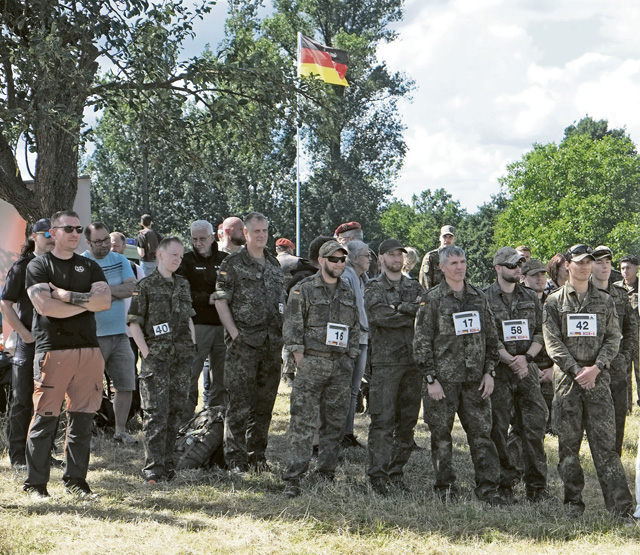
On June 5 and 6 the IG Heimatforschung Rheinland-Pfalz staged the second 100‑km/24‑hour Escape, Evasion & Remem-brance March from Waldsee, Germany to Hatten, France. Dozens of participants from across Europe and the United States, military veterans and determined civilians alike, gathered to honor the victims of World War II through a demanding, commemorative endurance event.
After a brief address by Waldsee’s mayor Claudia Klein, who also ran the march, twelve white doves were released as a symbol of international understanding. Organizer Erik Wieman then outlined the scenario: a wartime plane crash, parachute landings behind enemy lines, and an arduous route to the American lines at Hatten. Participants would face simulated minefields, water crossings, blocked routes, and team tasks designed to recreate the confusion, deprivation, and teamwork of wartime escape and evasion.
Four parachutists jumped to start the scenario, and a historic warbird flew overhead. A minute of silence honored all war victims before the march began.
The first 50 kilometers pushed participants across terrain marked by Allied and German memorials, bunkers, and tank barriers. Night marching followed, with reenactors blocking bridges and forcing detours. At Steinfeld, competitors crossed a tank ditch using single‑person inflatable survival rafts while lifeguards from the DLRG stood by.
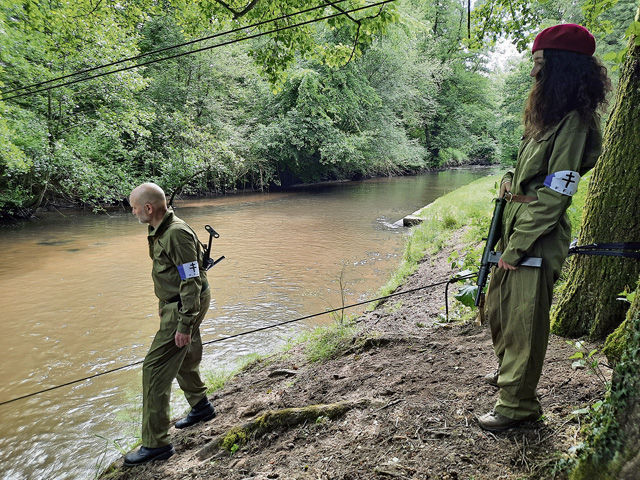
Around kilometer 82 teams found a “shot‑down American pilot” suspended in a tree – a 50‑kg training dummy in period uniform. The task required hiding the parachute and transporting the injured figure toward the American lines on a provisional stretcher. At kilometer 83 the border river had to be crossed on a double rope bridge while carrying the dummy, which even bore an original WWII dog tag. U.S. Army reenactors greeted participants on the German side; French Résistance actors awaited them on the French bank and issued the password for the American lines: Ghost. The counter password was Raven, a final test after a day and night without sleep.
The American lines at Hatten were represented by trenches and barriers near Casemate Esch, the site of fierce 1945 fighting.
The first finisher, a German police officer, completed the 100 km in 18 hours 25 minutes. In total 34 participants reached the finish; many others dropped out along the way. Volunteers, paramedics, and doctors provided continuous care, and there were no serious or lasting injuries.
At the finish the deputy mayor of Hatten awarded medals and certificates. A short reenactment followed in which German performers and an armored reconnaissance vehicle attacked the U.S. position and were repelled. The event closed on a symbolic note: sharing a beer together is better than shooting at each other.
The march combined intense physical challenge with historical remembrance, deliberately exposing participants to disorientation, hardship, and cooperative problem solving. It honored those rescued and those lost, while fostering international understanding through shared effort.
Organizer Erik Wieman summarized the event: this march is unique — an athletic, historical, and international form of remembrance — and he hopes many nations will return for the next edition in 2027.