 Twitter
 Facebook

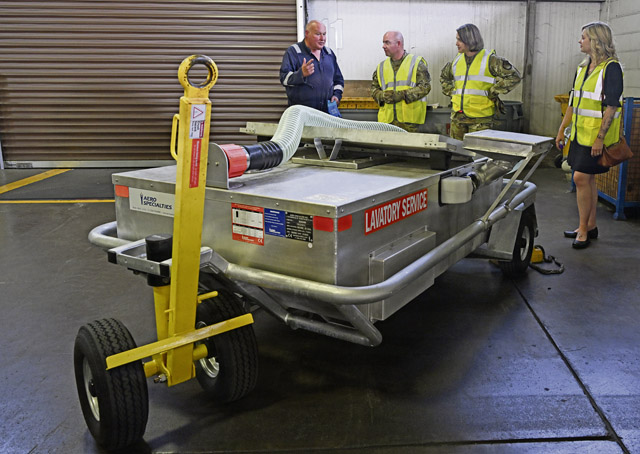
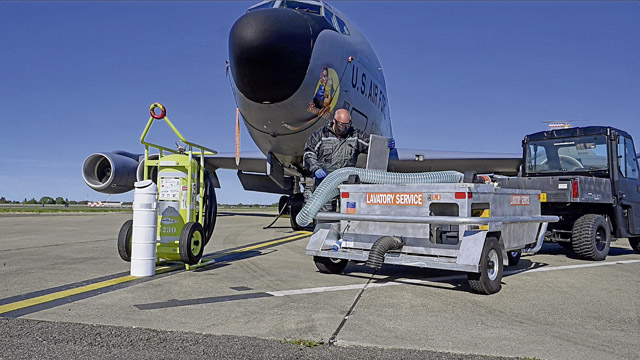
A towable lavatory service cart is giving the 727th Air Mobility Squadron another way to service aircraft at RAF Mildenhall, thanks to a team that saw potential in a simple piece of equipment.
Aircraft lavatories need to be emptied and replenished between flights, and fleet services teams typically use lavatory service trucks to remove waste and add fresh fluid. As the trucks age, they require increasingly regular maintenance.
What could have been a problem became an opportunity as the squadron discovered an innovative way to supplement the squadron’s trucks with a smaller piece of equipment: a humble cart.
“It was such a simple idea,” said Senior Master Sgt. Megan Johnson, 727th AMS operations superintendent. That simple idea has made a huge impact. While not as efficient as a truck in every situation, the carts cost around $18,000 each, a fraction of the approximately $605,000 price of a new lavatory service truck.
“From our ops team identifying suitable suppliers, to our resource advisor making funds available to our operators on the flightline validating that they meet the requirement, it was a true team effort,” said Major David Miller, 727th AMS commander. “It took our entire team to make it a reality.”
For Kevin Griggs, Templar Aviation Ltd. contractor who works as a fleet services supervisor, and the fleet services team, the cart has become a tool they use almost every day to support a critical function.
“We can really service everything that flies on this airfield now with that cart,” Griggs said. “Some of the guys like to use it more than the truck.”
The squadron now has three carts and this year they have been used to service hundreds of aircraft, including C-17 Globemaster IIIs, KC-46 Pegasus aircraft and commercial planes.
Since their introduction, the carts have reliably supplemented the squadron’s trucks, requiring no repairs, replacement parts or downtime. They also prolong the life cycle of the unit’s available trucks.
“The carts are so useful because they will never get deployed or sent TDY, so we can lean on them heavily at home station, which helps reduce mileage on our deployable trucks,” Miller said. “This means we have more capacity here at home station while also keeping our deployment capability green to respond at a moment’s notice.”
After putting them to work, the 727th AMS began identifying changes that would make them even more practical.
Lights were added for nighttime operations, as well as a voltmeter to show battery charge and a longer hose to connect with aircraft. Partnering with the 100th Air Refueling Wing’s metal shop, the squadron also developed a modified funnel and pipe to make servicing lavatories easier.
“I’m very happy with how far we’ve gotten with it in a short time,” Griggs said. “It’s only small things that we’ve done, but the small things help.”
The cart’s battery-powered pump and gravity-fed piping make it straightforward to operate. Its small size helps the team maneuver in tight spaces, while its stainless-steel construction makes it less susceptible to rust and corrosion.
“The other great thing about these carts is they’re so simple and they have so few moving parts, they don’t cause a lot of maintenance issues,” Johnson said. “It’s simple enough for us to fix ourselves without a maintenance entity coming to take a look at it.”
Now this capability is rolling its way beyond the 727th AMS. Within the 521st Air Mobility Operations Wing, the 724th AMS at Aviano Air Base, Italy, and the 726th AMS at Spangdahlem Air Base, Germany, have also started to use lavatory service carts.
For Griggs, who has worked as a contractor at Mildenhall for more than 30 years, the project reflects the experience and commitment of the Airmen and people doing the job every day.
“My team has been really, really good with this,” Griggs said. “Everyone who comes and visits and see them… they’re all so happy. You’re only as strong as the team behind you.”
Griggs said he knows fleet services may not be the most visible job on the flight line, but its work is essential to the squadron’s mission.
“That fleet team is amazing,” Johnson said. “It’s awesome to see that idea is now helping other squadrons solve the same problem that we’re all having enterprise wide.”
Across the 521st AMOW, personnel strengthen the en route system by turning practical ideas into capabilities they use every day.
“We’re proud to show it to anyone who comes and visits,” Griggs said. “I hope anyone who’s going to use it throughout the Air Force thinks the same as we do.”


