 Twitter
 Facebook
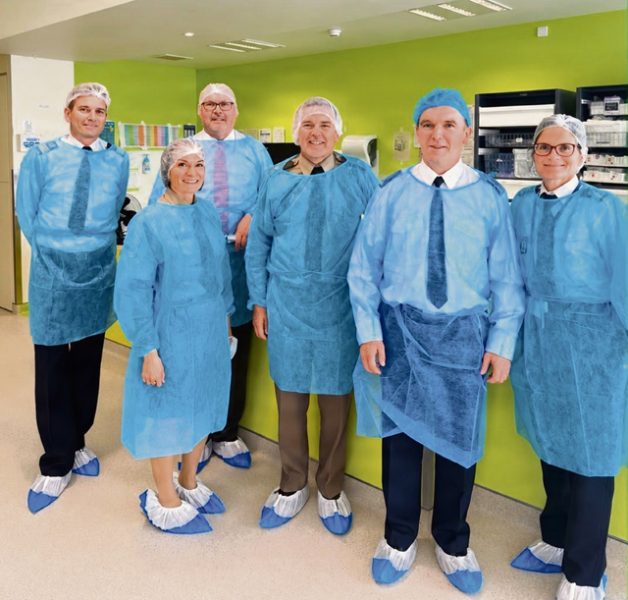
CLAMART, France — U.S. Army Brig. Gen. Mark Stackle, commander of Medical Readiness Command – Europe, and director of Defense Health Network Europe, recently visited the French Percy National Army Training Hospital to enhance bilateral medical relations and deepen cooperation between U.S. Army Medicine and the French Military Health Service.
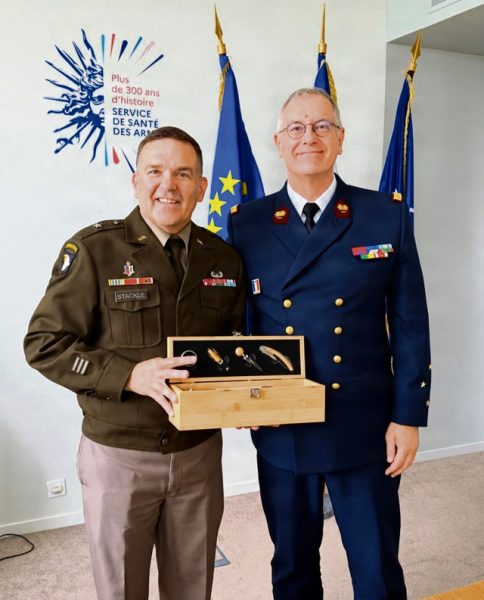
During the visit, Brig. Gen. Stackle met with French Brig. Gen. Isabelle Drouillard, Commander of the Percy Hospital, and other senior French Military Health Service leaders to discuss medical capabilities, operational readiness and opportunities to expand bilateral cooperation. The U.S. delegation received detailed briefings from Col. Prof. Nicolas Donat, head of Percy’s Burn Center, and Col. Dr. Leo Borrini, head of Rehabilitation, highlighting specialized capabilities with direct relevance to military trauma care and the recovery of wounded service members.
The visit represented another step in the expanding relationship between Percy Hospital and Landstuhl Regional Medical Center. The partnership developed through a series of reciprocal engagements focused on trauma care, burn care and operational medical readiness, creating opportunities for continued clinical exchanges and greater interoperability between U.S. and French military medical professionals.
“Building and sustaining strong partnerships with our French allies is vital to ensuring rapid, synchronized medical support during coalition operations,” Stackle said. “Engagements like this allow us to share clinical best practices and build the mutual trust necessary to save lives on the battlefield.”
Located in Clamart, southwest of Paris, the Percy National Army Training Hospital (HNIA Percy) is operated by the French Armed Forces Health Service under the Ministry of the Armed Forces. Its priority mission is providing operational medical support to deployed French armed forces and planning the equivalent of one full clinical service rotation annually for foreign missions. The military hospital also contributes to the French public health service.
Percy operates as a premier Level 1 trauma center and reference facility for severe polytrauma patients, including combat casualties, attack victims, and domestic trauma cases. Supported by a 1,300-member military and civilian staff, the facility maintains more than 300 beds. Its clinical scope encompasses emergency medicine, burn care, critical care, surgical services, imaging, pharmacy, physical and psychological rehabilitation, and the Main Center of Medical Expertise for aircrews.
Additionally, the Percy campus hosts two key specialized organizations of the French Armed Forces Health Service: the Armed Forces Blood Transfusion Center and the Armed Forces Radiological Protection Service.
“Collaborating closely with institutions of Percy’s caliber is essential to coalition readiness,” added Stackle. “Understanding each other’s clinical doctrines, specialized facilities, and operational capacities before a crisis occurs ensures our medical forces can seamlessly integrate during multinational contingencies.”
During the engagement, Stackle met with French Military Health Service officials to review medical capabilities and explore future operational cooperation.
“Touring Percy gave our team a much deeper appreciation of the French military’s sophisticated capabilities, particularly in burn management, critical care, and rehabilitation,” said Stackle. “Strengthening our bilateral relationship with the French military health community ensures Army Medicine remains fully aligned with our European partners.”
Also taking part in the engagement was Dr. John Casey, the global health engagement coordinator for Medical Readiness Command – Europe, who emphasized that reciprocal engagements establish long-term interoperability.
“Our engagements with French counterparts lay the groundwork for continuous clinical exchanges and coordinated planning,” said Casey. “These relationships translate directly into enhanced interoperability and a stronger allied medical posture throughout Europe.”
The engagement highlights the en-during com-mitment of Medical Readi-ness Com-mand, Europe, and Army Medicine to cultivate multi-national inter-operability and col-lec-tive readiness across NATO allies.


