Twitter
 Facebook
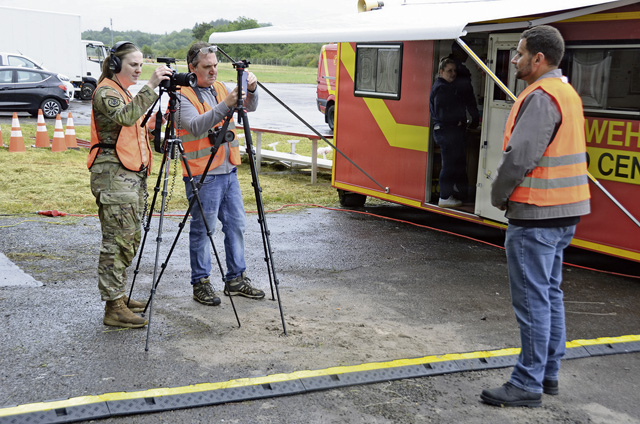
Story & photos by Bernd Mai
U.S. Army Garrison Rheinland-Pfalz
U.S. Army Garrison Rheinland-Pfalz emergency response teams partnered with German first responders for an Integrated Protection Exercise to test joint emergency response capabilities at the Baumholder Airfield near Reichenbach June 10.
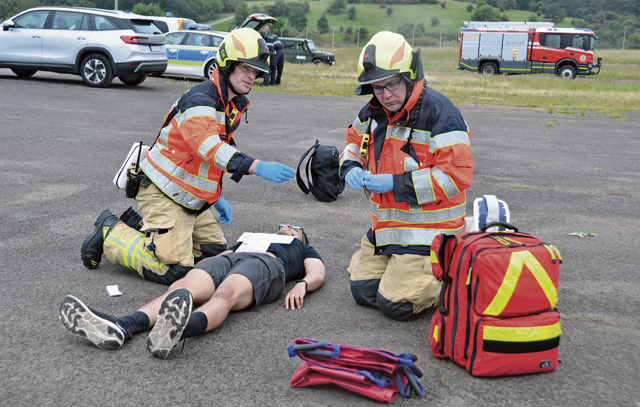
The exercise featured a complex mass casualty scenario to test interoperability between U.S. Army law enforcement, fire and medical personnel, and their German host-nation counterparts. The scenario simulated a vehicle plowing into a crowd, injuring several people during an event at the airfield. The vehicle then collided with another car, trapping one person inside.
The Baumholder Disaster Response Unit, German Red Cross, Baumholder Fire Department and local Polizei led the on-ground response efforts. Since first responders were already on-site at the fictional event, they intervened immediately. Together, they subdued the driver, secured the scene and provided initial medical care while calling for additional support.
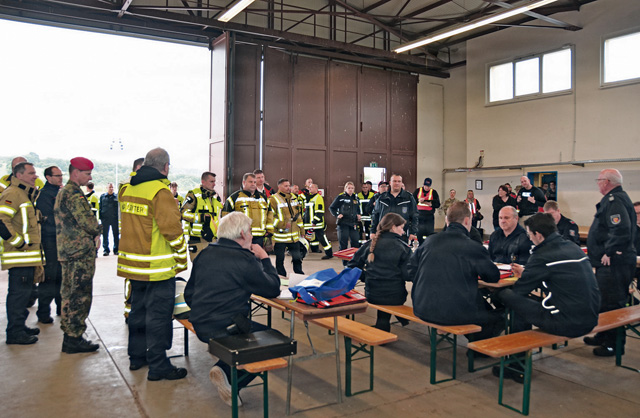
Additional German emergency responders, including the Reichenbach and Baumholder fire departments, arrived on scene shortly after. Emergency response leadership set up a joint command center in the airfield hangar to ensure full coordination and cooperation for a seamless response. Lukas Klein, Birkenfeld District fire and disaster protection inspector, took charge of the rescue operation.
During the exercise, first responders navigated an intense environment, with 13 on-scene actors providing realism through simulated injuries. Crews worked together to extract a trapped vehicle passenger while the Explosive Ordnance Disposal team managed a secondary threat – a simulated improvised explosive device disguised as a gym bag.
After about two hours, the exercise concluded with a joint debriefing.
“It was an excellent exercise to familiarize us with our partners’ capabilities,” summarized USAG Rheinland-Pfalz Police Chief Richard Robinson.
Chief Inspector Rouven Hebel of the Baumholder Police Station emphasized the importance of joint exercises.
“There are different ways of handling dangerous situations,” he said. “That is precisely why such exercises are very important.”
The exercise was also a success for the emergency medical services and fire departments.
Lukas Klein, Birkenfeld District fire and disaster protection inspector, was in charge of the rescue operation.
“We fully achieved our goal of testing our operational readiness while simultaneously improving our communication,” he said, adding that he hopes cooperation with U.S. partners can be further expanded in the future.
The large-scale effort required several months of planning and coordination across nine different organizations.
U.S. Army Garrison Rheinland-Pfalz sets, serves, and secures the total force community, enabling power projection for the European Theater.
“Two and a half years ago, I lost two stripes,” Campos said. “I went to a very dark and isolated place, watching all my peers progress and move forward. I started to neglect my health and started over-eating and drinking, all the things I shouldn’t have been doing.”
As the weight started to come off, other changes inside of his mind followed. After taking a hard look in the mirror at himself and his behaviors, he began reading more and became more intentional with his time. He’s also invested more of himself towards the mentorship programs and professional development initiatives.
Today, Campos serves as his unit’s booster club president, leads professional development efforts for the KMC First Four, helps physically train other members of his unit, and manages Wings of Wisdom, a mentorship initiative he founded after realizing how much guidance he lacked early in his Air Force career.
“I’m so glad I did because it helped me fix a lot of things in my life,” Campos said.
While the changes Campos has experienced are moving and deeply personal, he is not alone in his efforts to better himself, especially with the new standards being fully enforced come July.
Senior Airman Jurquis Jones, an 86th Force Support Squadron fitness specialist assigned to the Ramstein Fitness Assessment Cell, said he has seen an increase in Airmen preparing for the updated standards.
“Over the last few months, we are seeing fewer Airmen strictly lifting weights and now seeing these Airmen incorporating sustained cardio and functional fitness into their routines,” Jones said. “There also has been a spike in people asking for structured running programs rather than “winging it.’”
For Airmen waiting until the last minute to prepare, Jones offered a simple warning.
“Do not wait until a month out to start taking this seriously,” Jones said. “Consistency always beats intensity. You cannot cram for cardiovascular endurance. It takes time to build. Start small, get out on the track a couple of days a week to build the habit. Your future self will thank you when test day feels like another routine workout.”
Campos has firsthand experience that preparation extends beyond a single assessment. For him, preparing for these updated PT changes became more than meeting requirements. It was an opportunity to rebuild healthy habits, regain confidence and holistically improve himself. Campos’ fitness journey reflects the increasing efforts of Airmen across Ramstein, and across the force, to adapt to the updated fitness standards, one step at a time.
“The first step is always the hardest,” Campos said. “As soon as you take that first step, the next step is even easier.”